When we sat down to think about all the places in the world that we would like to visit, Alaska came out pretty much at the top of the list. Alaska is big and there is a lot to see. So, unfortunately, with only ten days to visit we had to make some difficult decisions.
We decided that rather than going inland we would concentrate on the coast which has spectacular scenery, the largest variety of wildlife and more Russian history than the rest of Alaska. We tried to see as much as possible of the coast by combining a self-organised trip to Kodiak with a cruise from Seward to Vancouver.
Kodiak
Kodiak was our first destination in Alaska. One reason we wanted to visit was its importance in the history of Russian America. As early as 1741 it was visited by a Russian expedition led by Vitus Bering. The sea otter pelts he brought back proved to be extremely valuable. Sea otters fur is more densely packed than that of any other mamal. That makes it waterproof and extremely warm. Russia quickly found that this high grade fur could be sold throughout Europe and, more importantly, it was one of the few things inward-looking China wanted from the outside world. That meant it could be bartered for Chinese items, such as tea and procelain, that were in huge demand in Europe.
Although we anticipated that finding out what remained of Kodiak’s Russian heritage would be fascinating, we also wanted to see the Kodiak’s empty landscape and wildlife that inhabits it. With this in mind, we had hired an RV and planned to camp. On Kodiak there are no restrictions on camping, so, if you don’t want to pay a small fee and camp on a site with basic facilities (there are three of them on Kodiak, you can camp wherever you can find space. For our first night, we decided to camp wild.
Our RV – a beautifully converted Ford Transit van (the best touch was most of the fittings were made of wood which gave it the feel of a cabin) was waiting for us at the airport. We headed south. There are only two roads on Kodiak, and neither is long. A couple of hours after we set off, we got to Surfers’ Beach almost at the end of the Pasagshak Road and stopped for the night. We couldn’t get the stove to work and had only cheese and crackers to eat. But, the lapping of the sea and the tranquil atmosphere it engendered meant that even a lack of hot food didn’t spoil our mood.
In the morning we carried on to Fossil Beach at the end of the road. After an enjoyable hour fossil hunting amongst the rocks that had fallen onto the beach from the cliffs behind it, we headed back to Pasagshak. It is famous for salmon and there were plenty of fishermen trying their luck. Unfortunately for them, as we learned later, the weather had been colder than normal and so most of the salmon were still out at sea. In the time we watched them the fishermen only caught one fish. Nonetheless, there was plenty of excitement as a bald eagle tried to steal the only other salmon the fishermen had hooked. We had hoped that we might buy a salmon from one of the fishermen for dinner. But having only caught a couple they were not keen to sell!
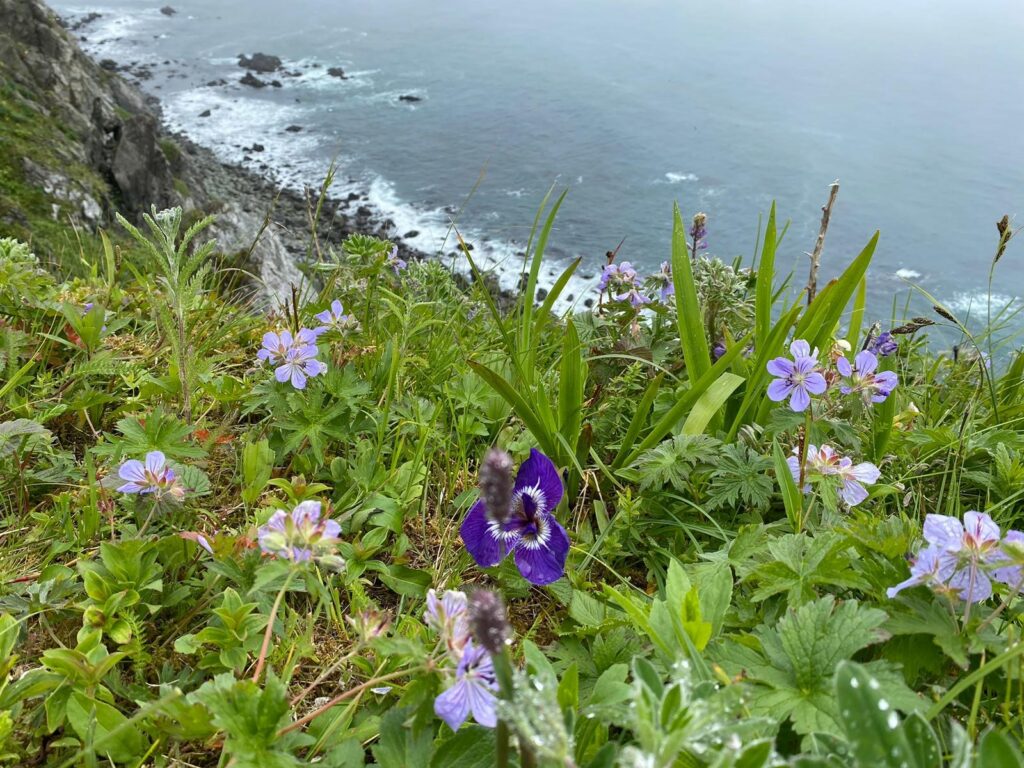
The second night on Kodiak we camped at Pasagshak Point (picture above), a fifteen-minute drive down an unsurfaced road. Once again, we were completely alone, and the views, as you can see, were spectacular. Although we had no salmon, we got the gas going and had a meal of warm noodles sitting by the fire we lit. It was the best of our evenings on Kodiak.
Early the next morning we headed back down the Pasagshak Road to Kodiak Town. Originally called Pavlovskaya Gavan (Paul’s Harbour), it holds a central place in the history of early Russian America. When, in 1784, the Shelikov-Golikov Company established its first trading post on Kodiak, it was at Three Saints Bay. But, eight years later, in 1792, Alexander Baranov, manager of the Company, moved his headquarters to what is now Kodiak, because he thought the location was easier to defend. With that move Pavlovskaya Gavan became the de facto capital of Russian America.
It rained for the entire drive, but we were excited to arrive in Kodiak. We had booked a floatplane trip to go bear watching and were looking forward to it. So, it was disappointing to be told the tour was cancelled because of the bad weather. Our flight out of Kodiak was the next day so we thought we had lost our chance to see the famous Kodiak bears. It was a relief when, the company (Sea Hawk Air) said they expected the weather to improve and we could go on the trip the following morning. They would get us back in time to catch our plane to Anchorage. We grabbed the chance and spent the rest of a very rainy day looking around Kodiak (which we had planned to do the next day). We managed to see most of it.
Only one building from the Russian period is still standing – the Russian-America Magazin (built 1810), a typical Russian style log construction where furs were stored before being shipped out of Kodkiak. It is now a museum dedicated to Kodiak’s history. Unfortunately, it wasn’t open the day we visited.
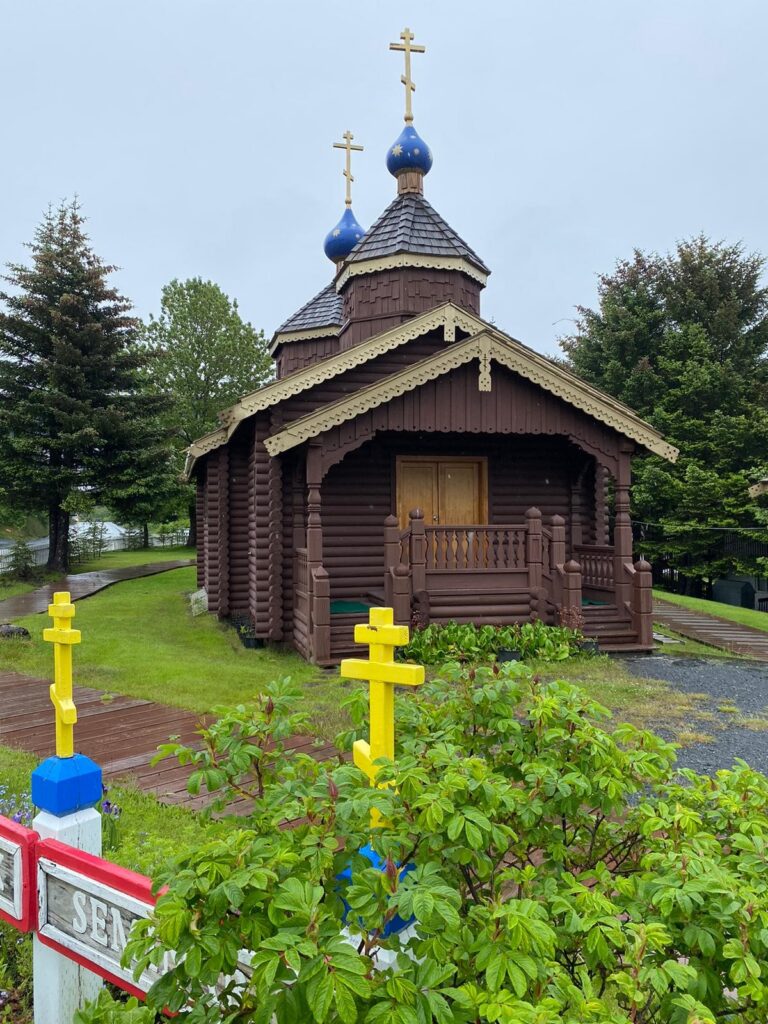
The religious legacy from the Russian period is still strong on Kodiak and there are several Orthodox churches and chapels in town. We visited the Holy Resurection Church. The building is not the original one – that burned down in 1943 – but it was rebuilt in the same location. We were surprised to learn that although the original bells were cast in Kodiak, by 1945 replacements could no longer be made locally and new bells had to be ordered from Paris.
In addition to the churches there is a also a working seminary in Kodiak (St Herman Seminary) which trains Orthodox priests. It has its own small, very pictureque chapel (picture left). Although we could not go in the chapel we ejoyed seeing it and tranquil atmosphere it seemed to create.
For our last night on Kodiak, we camped at the Fort Abercombie State Historic Park. The area was heavily wooded and quite different to the landscape around Pasagshak. There were some interesting walks through the forest, and we are sure we would have enjoyed them. Unfortunately, when we attempted to explore it was still raining. So, we quickly retreated to the van.
Our last day on Kodiak was bright and sunny and when we arrived at the harbour, we were pleased to hear that the floatplane trip was on We had expected to be taken to Frazer Lake in the southwest of the island, one of the paces bears gather to catch salmon as they swim upstream. However, because the salmon weren’t swimming, the bears weren’t gathering and, instead, the guide decided to take us to a beach on the coast of the Katami National Park.
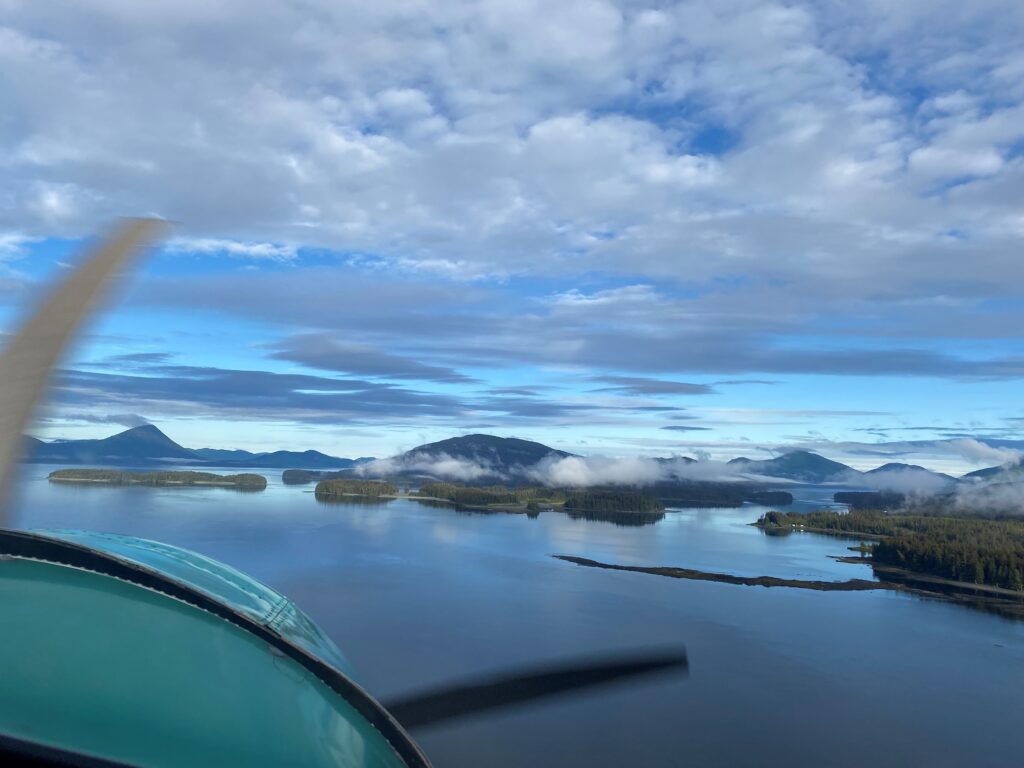
On the way we flew over several of the islands in the Kodiak Archipelago. The views were spectacular with plumes of pollen rising off the spruce trees and huge rafts of sea otters swimming in the sea.
One of the islands we passed was Afognak. Being more remote than the main island, traditions were better there than on the main island and Russian was widely spoken until the Great Alaskan Earthquake and Tsunami of 1964. Afognak was badly hit and by the tsunami and many members of the community were rehoused on the main island. Russian is now spoken by only a handful of elderly inhabitants. As we flew over the site of one of the villages destroyed in the disaster we saw the sole remaining building, an Orthodox church.
A little later we passed Phoenix Bay, where wooden ships were built during the Russian period.
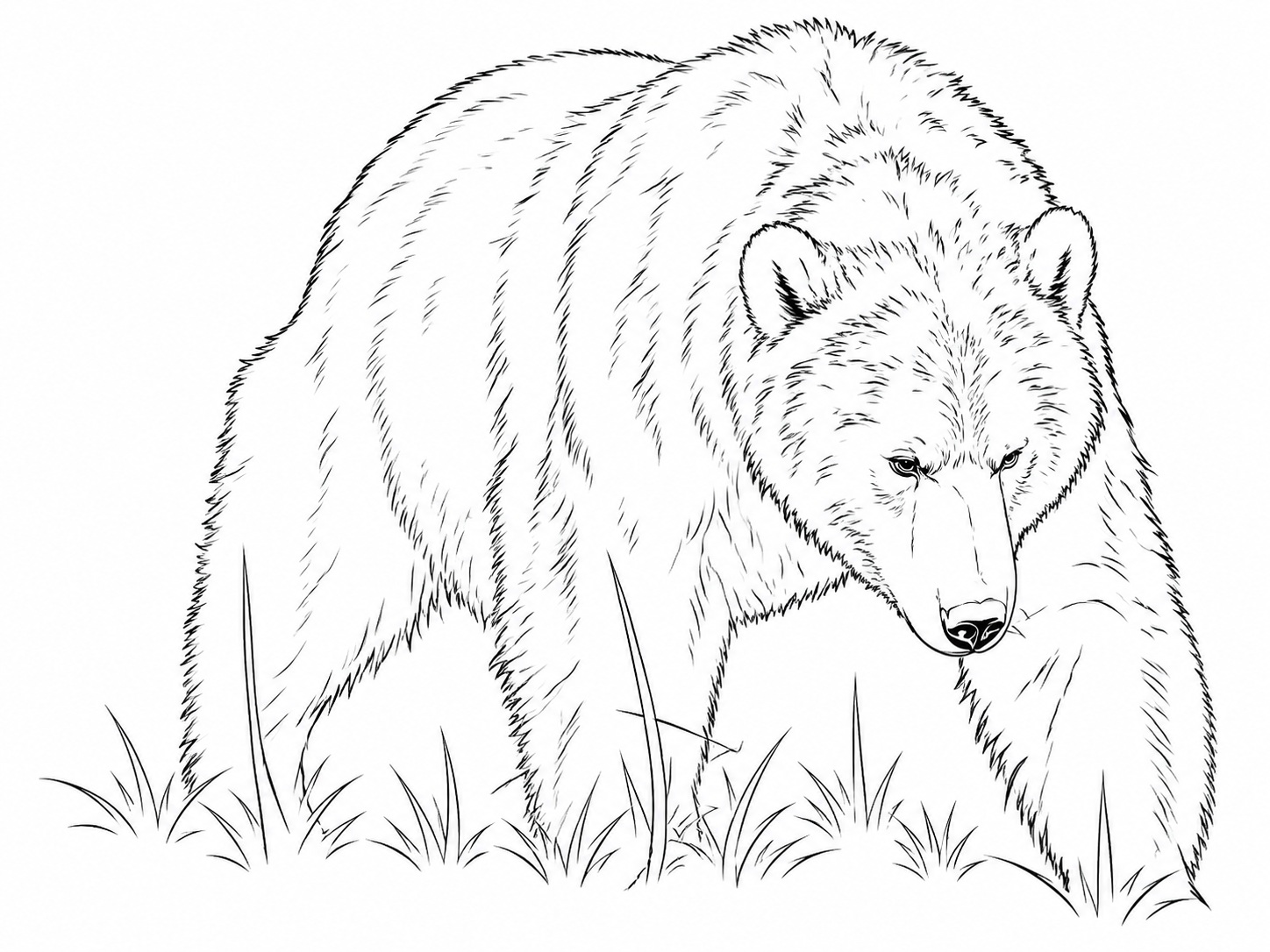
Although the flight was amazing, what greeted us when we arrived was even more so. Our guide, who said she had been watching bears for thirty years, led us on a walk around the beach and marshy area immediately behind it. Over the two to three hours it took we must have seen somewhere between 30 and 40 bears. How close we got to the bears (less than 5 meters at times) and how much the guide was able to tell us about them both made the trip very special.
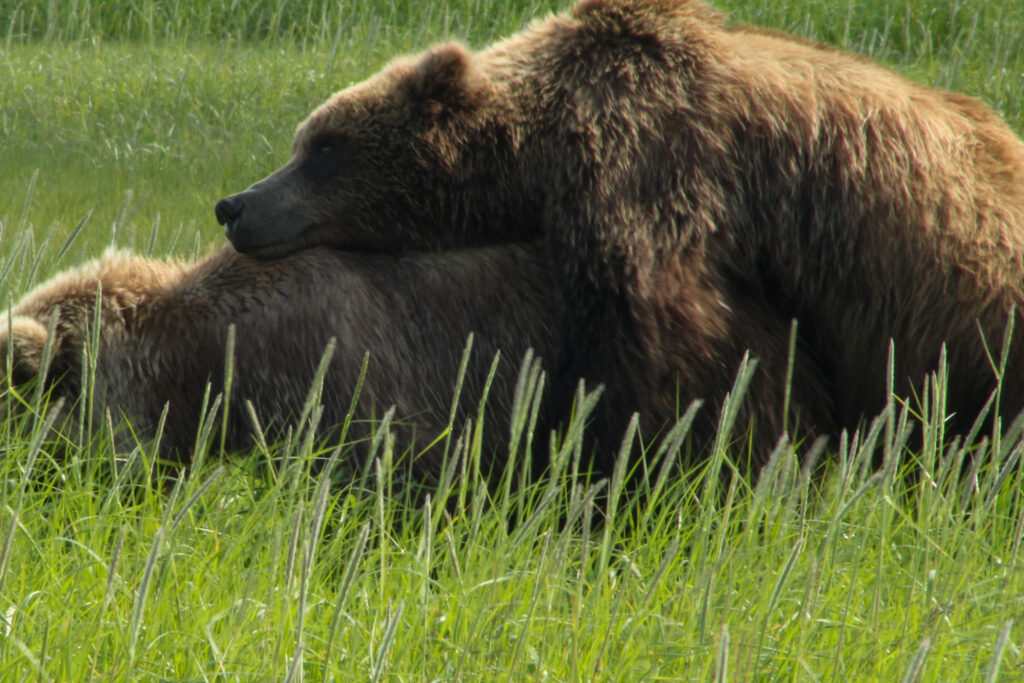
The guide was able to show us how to approach the bears without alarming them (keep close together so that they only had one object to focus on and stop if they started to turn their back on us) all about their eating habits (moving from location to location to eat the best of what was in season) and even about the history of individual bears. It was interesting that even though the guide could distinguish individual bears from each other she said they never named them. Doing that would show a lack of respect and would turn them into something close to pets which they definitely were not!
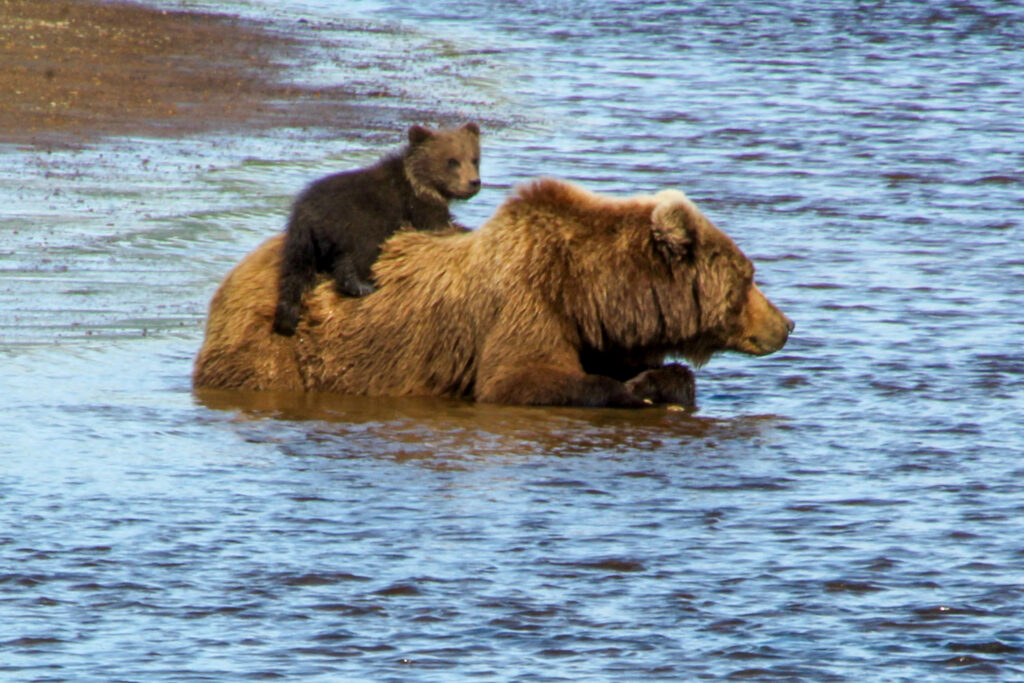
But the walk wasn’t without some sad moments. Talking about the bear in the picture above, the guide told us that the day before we visited a male bear had attacked her cubs, killing two out of three of them. So, at the time of our visit it was clear that she was being super-protective of the one remaining cub. Although she seemed very distressed most of the other bears, especially those in the other picture, appeared to be enjoying life!
Cruise
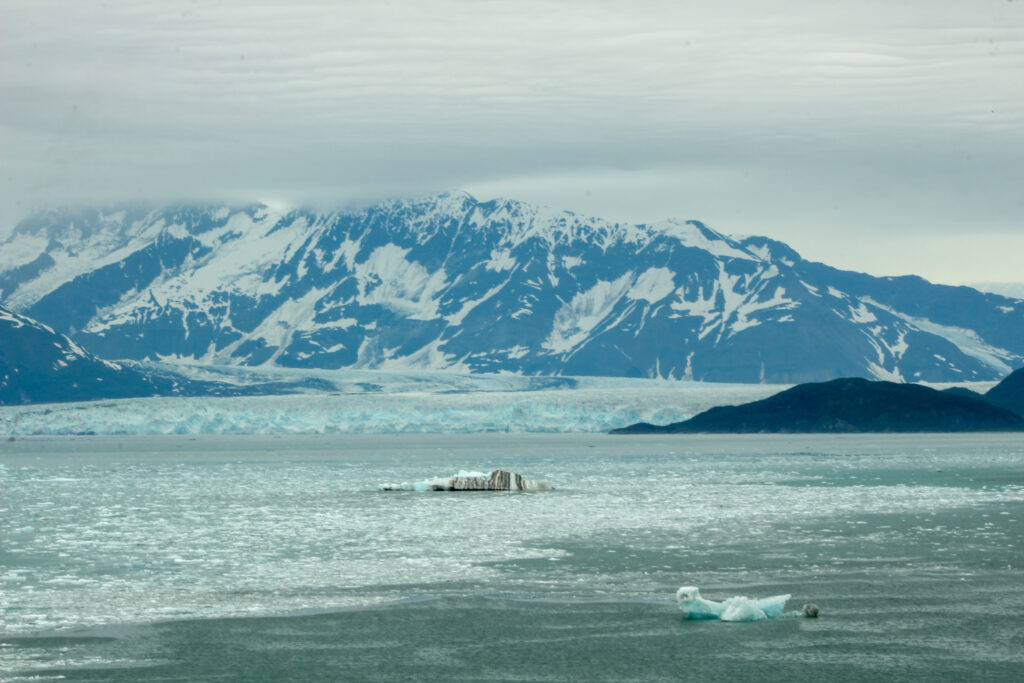
When we were planning our trip, we were somewhat ambivalent about the idea of sailing on a cruise ship, but logistically it was the most efficient way to visit the largest number of places along the Alaskan coast (many of the towns along the coast can only be sea or air and trying to visit them by air would have meant multiple flights back and forward to Anchorage). So, we went for it. Cruising turned out to be an experience its own right. Having unlimited food and drink, entertainment ranging from musical shows to lectures and a choice of organised outings in every port made for a surprisingly relaxing experience. We particularly enjoyed the quizzes and table tennis competitions. We also met some interesting people. On the downside, the towns we visited were swamped by tourists when a cruise ship was in town (and in several places there were multiple ships), it was restrictive having to follow a strict timetable and we didn’t have much in common with most of the passengers. So, although it was worth doing once, it is probably not something we would want to do again.
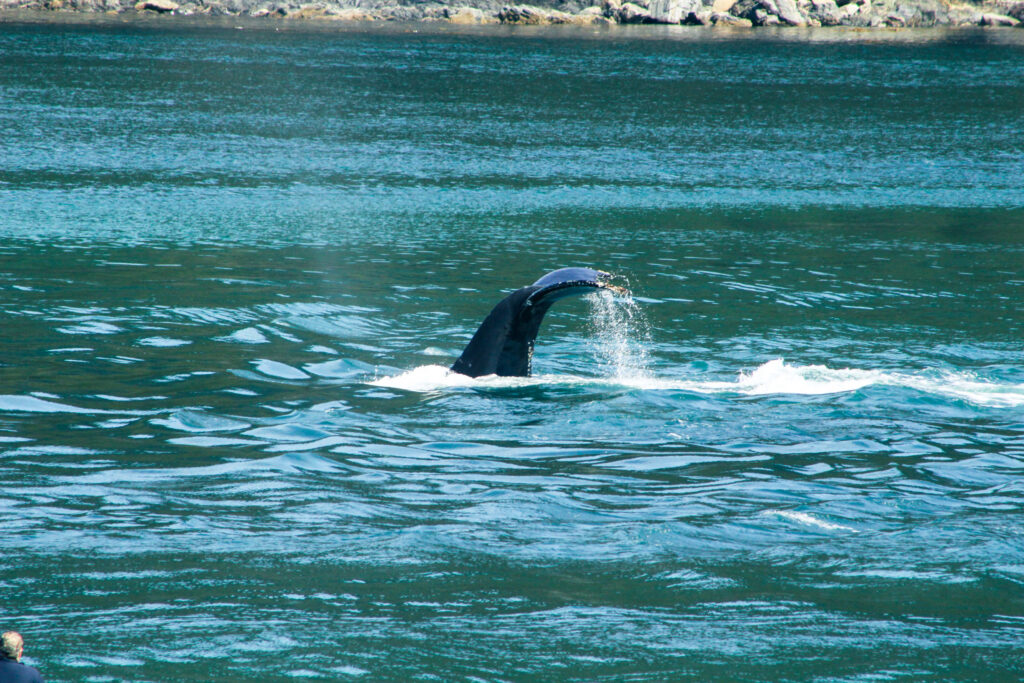
Of the places we visited, Juneau and Sitka were probably the most interesting. In Juneau we found out that Alaska has, for a long time, had a large Filipino community (the first Filipino sailor arrived in 1788) and saw a monument dedicated to people who died in was effectively an internment camp after being moved to Juneau from the Aleutian Island by the US after Japan invaded during the Second World War. 95% of the names (given and family names) were Russian. While we were in Jueau we also went whale-watching and were lucky enough to see humpback whales bubble-net feeding. This is a form of group hunting that is not instinctual but learned. One whale directs the others as they circle a school of small fish. One in place they create a net of bubbles to coral the fish and drive them upwards into a confined space. Then the lead whale sounds a feeding call, they al simultaneously swim upwards with mouths open to feed on the trapped fish.
Sitka (originally called, Novo-Arkhangelsk) was interesting for its Russian history. Founded by Baranov in 1799 it was subject to periodic attacks from the local Tinglit tribes up to 1802, when it was destroyed. All the inhabitants were killed or taken prisoner. Baranov returned in 1804 with more men and, after what was a very closely fought battle, managed to defeat the Tinglit. He immediately rebuilt Novo-Arkhangelsk, ensuring that it was well fortified. In 1808 it became the official capital of Russian America, taking over from Pavlovskaya Gavan, and retained that role for more than sixty years, right up to 1867, when Alaska was sold to the US. Unlike Pavlovskaya Gavan, which was never really anything more than a trading post, Novo-Arkhangelsk was a place where Russia wanted to display its culture and sophistication.
We wondered if there were still any Russian speakers in the town. So, when we saw a Russian souvenir shop selling Matryoshka dolls and a lot of other typical Russian tourist products, we went in. We heard two of the people working in the shop and started to talk to them. It turned out they had only been in Sitka for two years and had moved there from Moscow! All the products they sold were imported. We asked them if there was still a Russian-speaking community in the town and they told us that there was not. We got the same answer when we spoke to a priest in main Orthodox church in the town, St Michael’s Cathedral. He was Polish and told us that none of his congregation spoke Russian.
Whilst in town we visited the Russian Bishop’s House. This building, which is now a free museum, dates from the Russian period (built 1843) and was the home of Bishop Innokenty Veniaminov, a missionary and the first Russian Bishop of America. The bishop, who was later Metropolitan of Moscow and eventually sainted, learnt several local languages, wrote many of the earliest scholarly works about the native peoples of Alaska, devised writing systems for local languages, wrote dictionaries and grammars for those languages and translated parts of the Bible into them. The only way to see the house was as part of an organised tour. The guide was very knowledgeable and had a lot of interesting things to tell us. But one of his comments in particular has stayed with me. When renovating the building they found a lot of discarded documents which had been used as insulation. Reading them had provided the team with a lot of information about life in Novo-Arkhangelsk at the time.
Probably what we enjoyed most was the main Orthodox cemetery (referred to as the Russian Cemetery). This was in the woods. Rather overgrown and neglected, it had a calm peaceful atmosphere. We looked at a lot of graves in it. Many, although not all, were Russian names and they ranged in date from the Russian period right through to the contemporary.There are a lot of other historical sites around Sitka – Baranov Castle Hill (which was Baranov’s home and the centre of Novo-Arkhangelsk social life and also the place where Alaska was formerly handed over to the US), a reconstructed Russian block house that had formed part of the fortifications for the town, the grave of Jacob Netsvetov, the first native Alaskan to become an Orthodox Priest (went to Irkutsk for training) and also the first native Alaskan to become an Orthodox saint and the grave of Princess (Knyagina) Maksoutoff’s, the first wife of the last Russian Governor of Alaska, Dimitri Maksoutoff. But, probably what we enjoyed most was the main Orthodox cemetery (referred to as the Russian Cemetery). This was in the woods. Rather overgrown and neglected, it had a calm peaceful atmosphere. We looked at a lot of graves. Many, although not all, had Russian names and ranged in date from the Russian period right through to the contemporary.
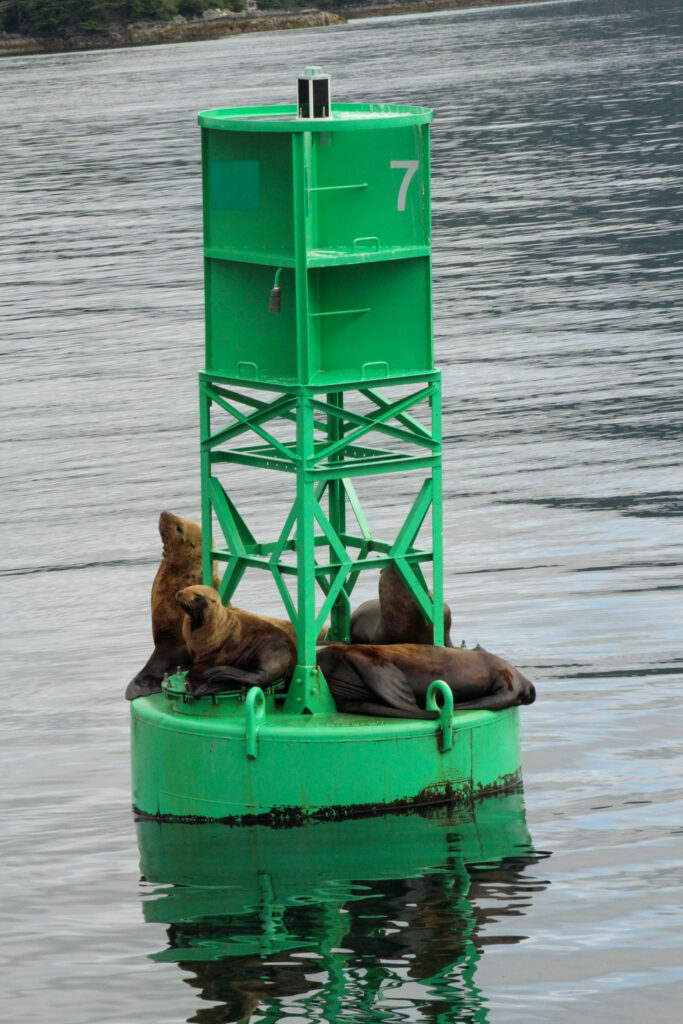
Whilst in Sitka, in addition to looking around the town, we also went on a boat trip. The highlight of that trip was seeing harbour seals on a buoy (picture right).
By the end of our time in Alaska we felt that we had got a real taste of the place. But there is much more to see – the Denali National Park, the West Coast, the DiomedeIslands where in winter you can walk on the ice from the USA to Russia, the Far North and my personal want-to-see, Unalaska. So, we may well be tempted back!
When we visited: 9th-20th July 2023
Leave a Reply