Sampling local foods, visiting historic towns and seeing the famous coastline were some of the things that drew us to Normandy and Brittany.
We decided to go by car because we thought that would be the easiest way to see as much as possible and, of course, it meant we would be able to bring plenty of local produce back to England with us. At the time we had recently bought our first fully electric car – this was to be our first long trip in it. We were a little apprehensive about finding places to charge the car but at the time didn’t realise how brave (or reckless depending on how you look at things) the decision was. Starting the first day, when we almost ran out of power before getting to Rouen, charging the car provided us with a series of mini adventures. Although these were often nerve-racking (we eventually got to a place in Rouen, the local MacDonalds, where we could charge the car with less than 2km worth of power left) they also meant we met a lot of people that we would never have had contact with otherwise.
Typical of these adventures was one in a small village near Caen where we stopped to get a bite to each and charge the car en route from Rouen to St Malo. We happily plugged into a charging station in the car park of the local Mairie and went to get some food. When we got back, we tried to unplug but couldn’t open the hatch on the charging point. Somebody who worked in the Mairie, two passing workmen and an elderly lady who lived across from the car park and happened to own an original Monet all tried to help in their own way – talking to the company that owned the charger on our behalf (we needed it as my French wasn’t up to it), trying, unsuccessfully, to pry the door open with a crowbar and making tea for us. Just as we thought we were going to be in the car park all night the hatch on the charging point mysteriously opened by itself.
Rouen
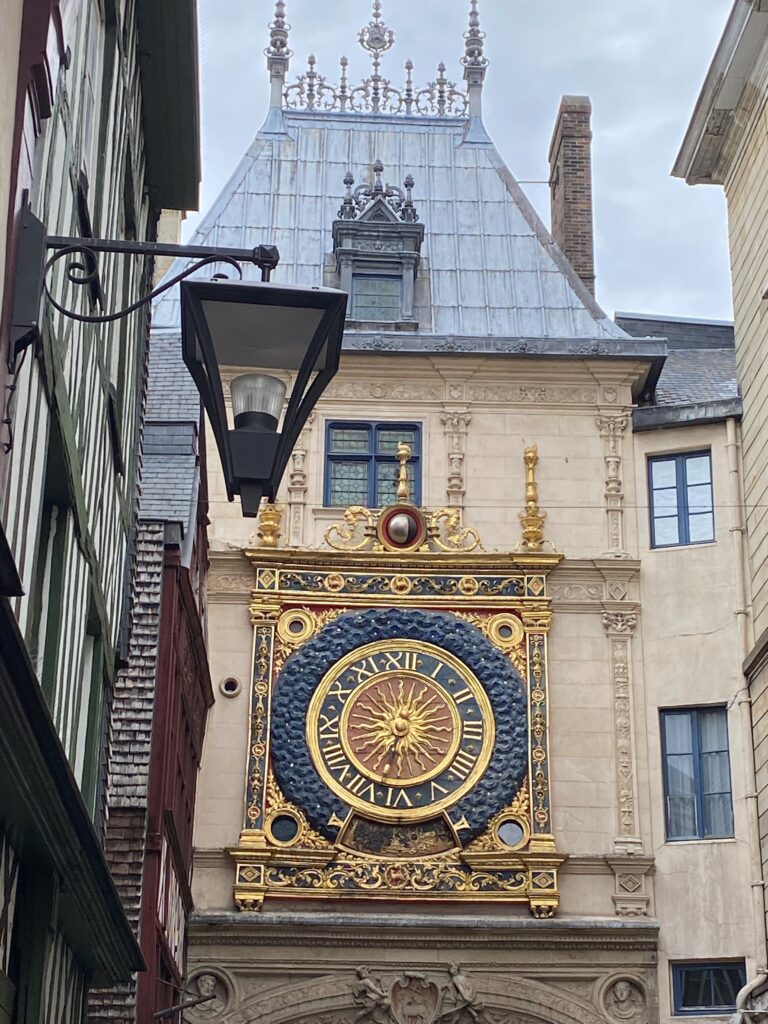
From the first night in Rouen when we sat in the small garden of the flat, we had rented drinking wine and eating cheese, we felt we were in France. The feeling continued the next day over breakfast which was croissants bought that morning from a local boulangerie.
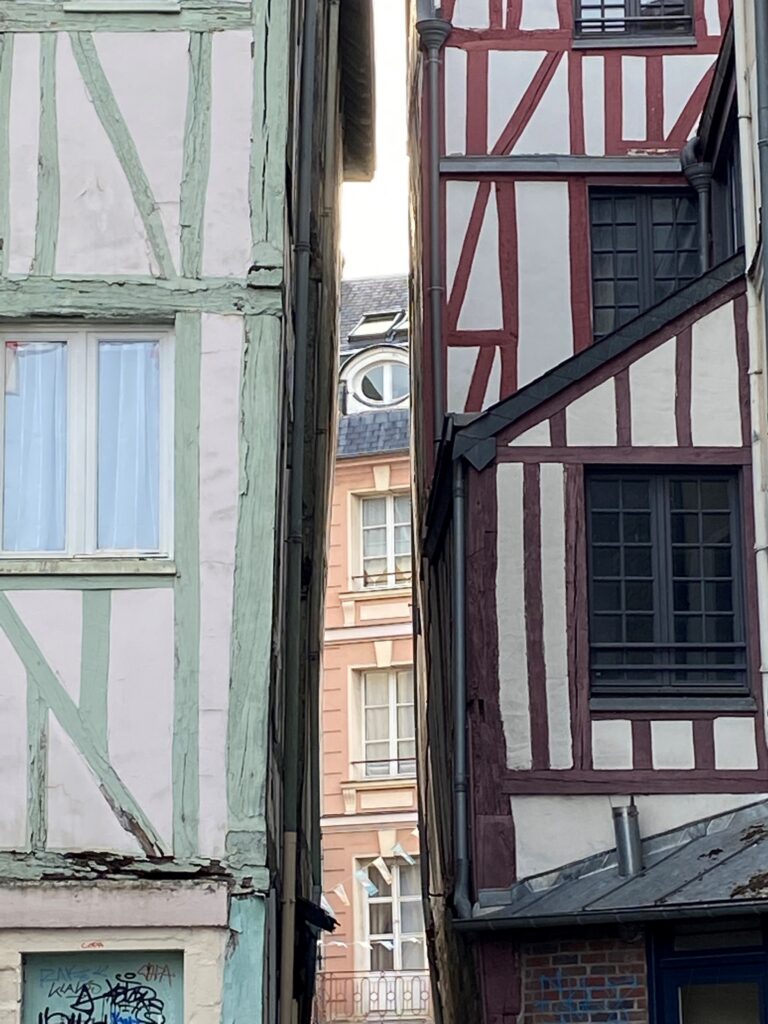
When we got a chance to explore Rouen, it turned out to be a great city to walk around. The centre is large for such an old town but not so large that you can’t get anywhere you want on foot.
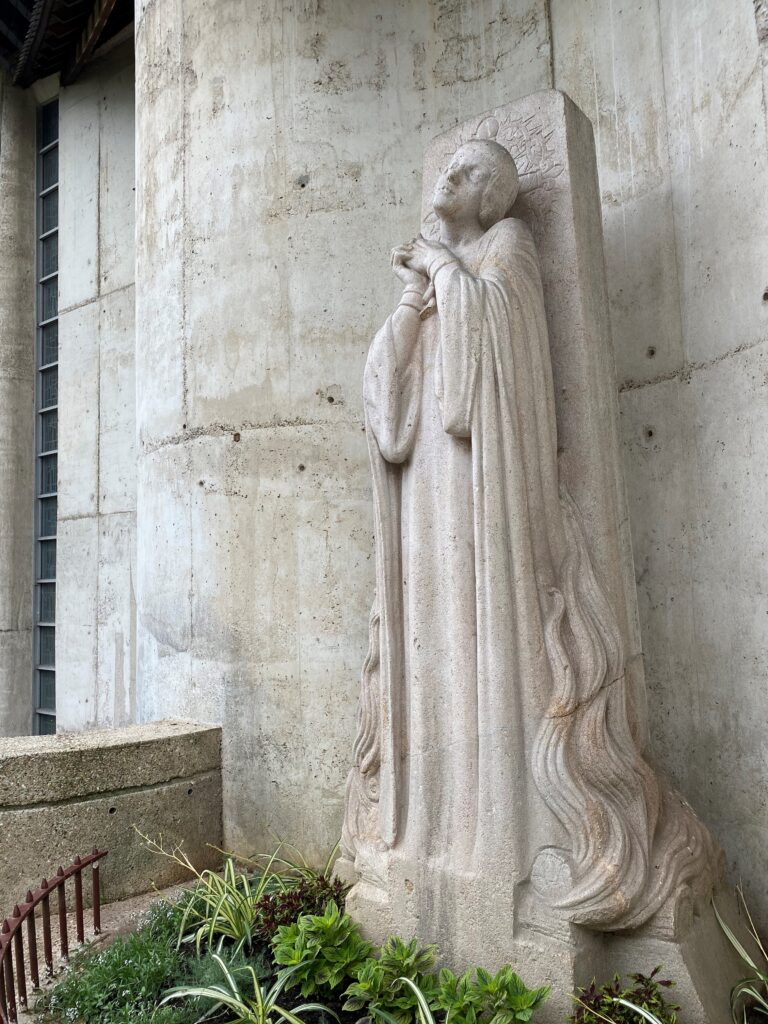
We, of course, visited the monument to Joan of Arc, the church dedicated to her and the Cathedrale Notre-Dame de Rouen, which are in all the guidebooks. The Cathedral, particularly the carving on its front is spectacular and not to be missed.
However, what we enjoyed the most was taking in the atmosphere as we walked around the streets.
That, and visiting the market in the centre of town where we bought an excellent selection of local cheeses. The Neufchatel (named after the nearby town where it is made), a soft, slightly crumbly cheese that looks like Camembert and Brie but has a saltier and sharper taste. We only found out later that it is one of the oldest types of cheese in France – it was being made as far back as the 6th century.
Giverny
A visit to Giverny to see Monet’s house and garden was one of our “must do” items for this trip. From Rouen it is an easy day trip by car. We set off relatively early and got there around midday after a stop at MacDonalds on the way (MacDonalds and Lidl’s proved the most reliable and, since they both provided free charging for customers, cheapest places to charge the car).
From the moment we got to the car park it was evident that things were going to be crowded. But, having come so far, we were not going to turn round. We had bought tickets in advance and so could have avoided a long wait if we had realised, we didn’t need to join the queue at the ticket office! When we first got into the garden, I thought that we were going to be disappointed. There were lots of pretty flowers, but the planting didn’t really seem inspiring – everything was crammed together and nowhere did you get any sense of perspective or expanse.
Things picked up when we go into the house. The displays in the house, including a lot of Monet’s pictures that we hadn’t seen before were interesting. Then, on going upstairs it was possible to see the garden in a completely different way. Looking down from the first-floor windows you could see that the garden looked its best from above – each area of densely packed colour contributing to the overall impression.
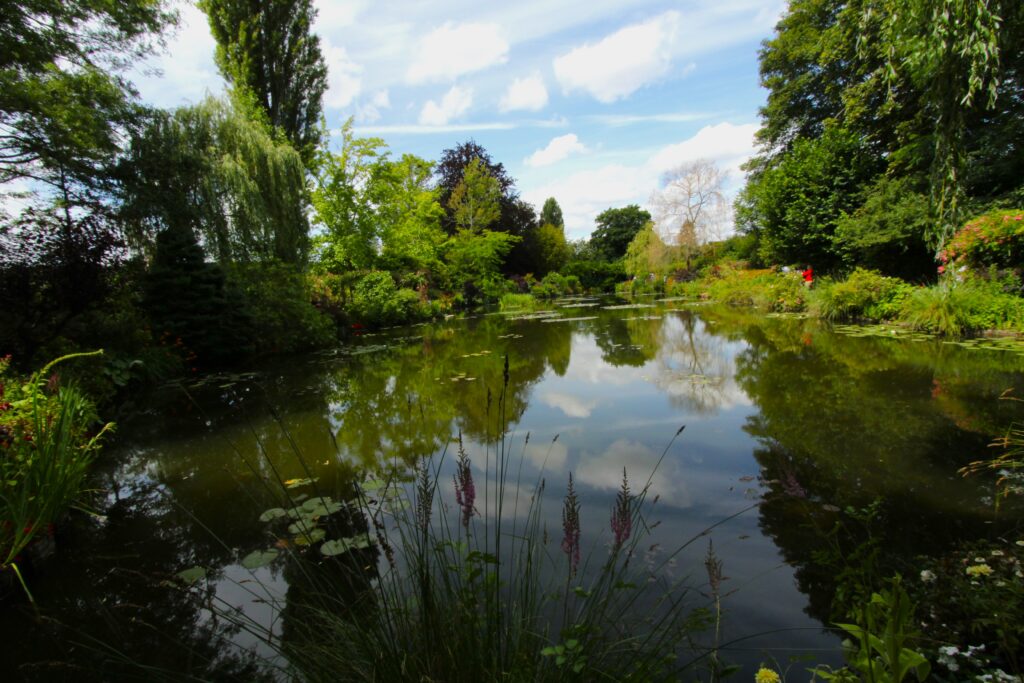
Even better than the main garden and house was the more distant and wilder part of the garden near the pond. Arriving there to see the water lilies and the clouds reflected on the smooth surface was a special moment – suddenly we understood in way that was not possible before that the paintings we had seen so many times were representations of a real place rather than something conjured from the artist’s imagination
St Malo
St Malo, which is apparently named after a Welsh saint who travelled to Brittany, was the first place we stopped in Brittany. Having said that, I am not entirely sure it is right to call it Brittany since the town’s motto is “Ni Français, ni Breton, Malouin suis” (not French, not Breton, but Malouin).
Whatever is right, it is a city of picturesque views – much of the town sits high above the sea. Our hotel was on a promenade above the Grande Plage du Silon. The view from the promenade were great. The part of town where we were staying was not the oldest but had a kind of slightly faded charm. The historic centre however boasts a lot of interesting buildings. Since St Malo was an important naval base many of these are military buildings. Until I read up on it, I didn’t realise that St Malo was also a renowned centre for the corsairs (privateers/pirates) that used to carry out partial sanctioned raids, on British ships, in the English Channel.
One small fort sits on what is an island at high tide. At low tide, the island is no longer an island, but instead is joined to the mainland by a spit of sand. We ventured out to the fort on the flood tide, looked around and then, because of the speed with which the water came in, had to take off our shoes and roll up our trousers to wade back! On the same walk, we did a circle the top of the entire length of the walls that surround the historic centre of town.
St Malo is famous for its seafood, so we tried what was available. The first night we ate at a place called Le Brasserie du Sillon near our hotel. The location is ideal, the very first building on the long promenade, with one side right on the road and the other with views out over the bay and the food, the restaurant had a pretty good traditional seafood-based menu. The second night, although we looked all round town, we ended up eating in a small place even closer to hotel. This was a lot simpler than the place we ate the night before, but we enjoyed it even more. Elena had moules-frites (mussels and chips) which they offered with a variety of different sauces, and I had galettes – savoury buckwheat pancakes.
Cancale
While in St Malo we made a side trip to Cancale which is only a short drive (less than half an hour) away.
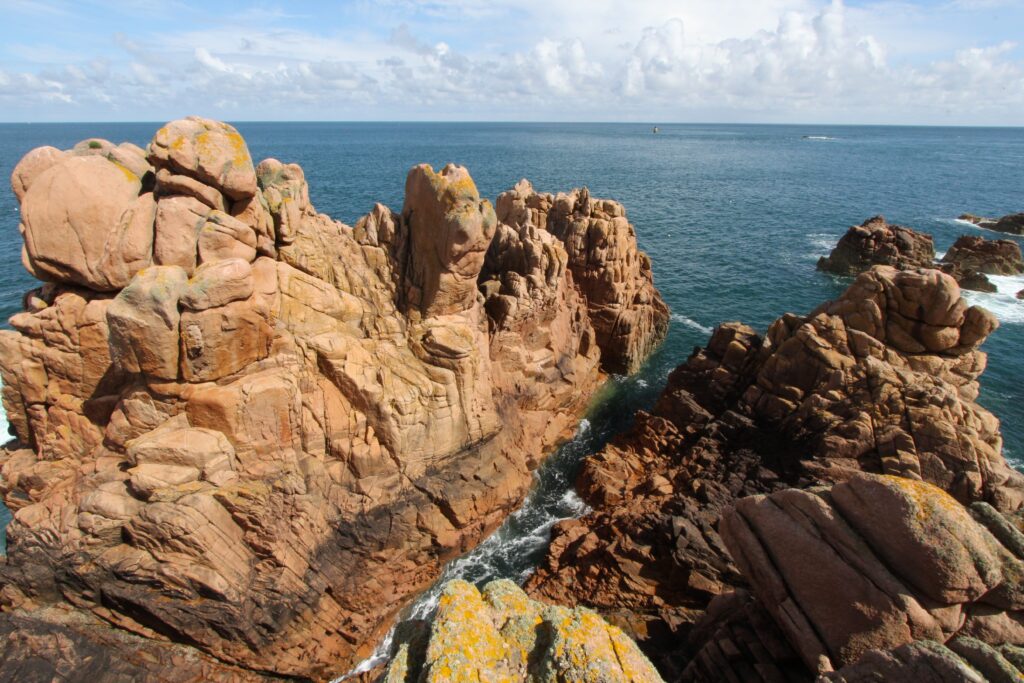
Before going into the town itself we went to the Pointe du Grouin a peninsula which is also the most northerly part of the local coastline. We walked out to the end of the peninsula which has spectacular views of the rocky coastline in both directions. While there we spent a lot of time watching a group of amateur canoists struggling to make headway against the tide. What was originally a single group quickly became four or five with their instructors doing their best to haerd them all back together!
Cancale was incredibly crowded and we struggled to find a place to park even in a paid car park. The attraction are the local oysters. These are known as the best in France and people come a long way to eat them fresh! We, of course, tried them. Getting ours from one of the many stalls on the dock-front and sitting there to eat them. We tried two local varieties (surprisingly very different) on the recommendation of the seller and enjoyed them both.
Ile-de-Brehat
When we left St Malo, we headed west to Ploubazlanec, a couple of hours drive along the coast. On the way we stopped for a break in Binic-Étables-sur-Mer. We bought some food in the local Carrefour and sat on a bench near the sea to eat it. The visit was unplanned but fortuitous. The town had obviously relied on fishing for much of its existence but was now also catering for tourists. Despite that it was relatively quiet and gave out a pleasant aura of slightly faded charm, almost as if, despite trying, it had been overlooked – a nice contrast to the out and out commercialism of some of the other places we visited. After lunch we walked the length of its small port and marina to a little beach just around the corner, grabbed some pastries at the local pâtisserie and headed on.
We were staying in a bed and breakfast on the edge of Ploubazlanec. When we arrived the first thing that struck us were the beautiful hydrangeas in the garden (there are a lot of hydrangeas in Brittany), then that we had arrived early and the owner (who turned out to be very hospitable and served us an excellent breakfast the next morning) wasn’t home.
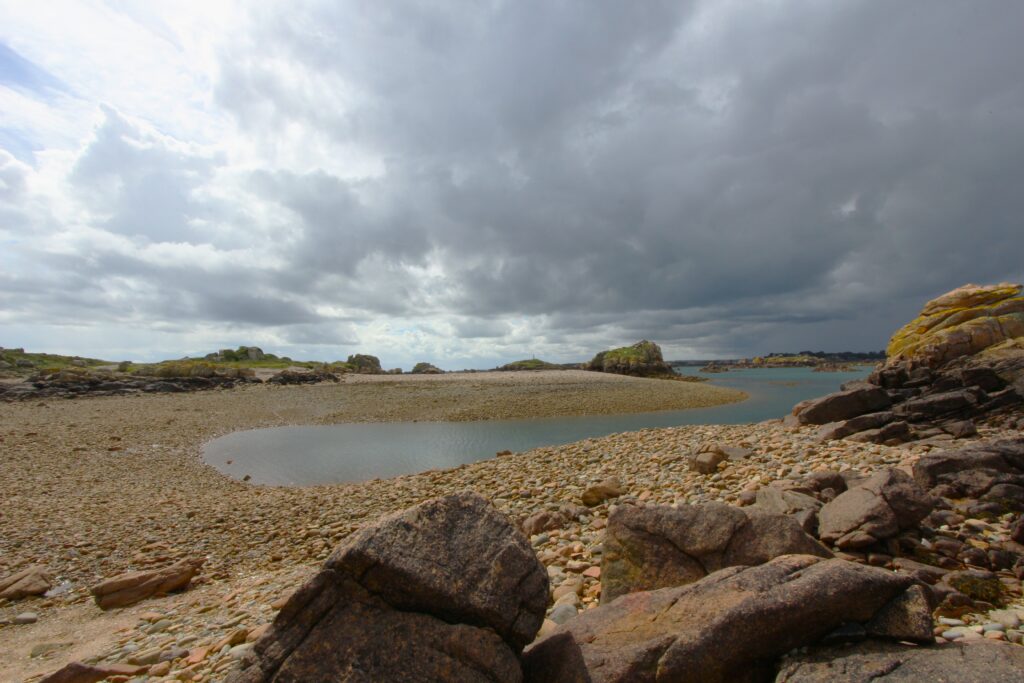
We went for a short walk down to a nearby beach (nowhere in Brittany seems to be very far from a beach) and made it back in time before it started raining. The place we were staying didn’t serve evening meals, but the owner recommended a place down near the port. On the map it didn’t look far, and we thought about walking. In the end we took the car and were glad that we did because we got soaked even in the short distance from the car to the restaurant. The moules-frites (again) made up for it!
The point of staying in Ploubazlanec wasn’t so much to see it (although we did enjoy our stay there) but as a staging point to get to the Île-de-Bréhat, an island (or rather an archipelago with two main islands joined by a small bridge) about a mile off the mainland. The island, known as the island of flowers, is famous for its mediterranean vegetation (it manages to grow here because of unique micro-climate caused by the Gulf Stream) and as having been popular with artists, Marc Chagall amongst them. The island has a pretty town near the ferry landing point, but it is was rather crowded when we visited. We walked to the other end of the island – Paon lighthouse and founds some spots there and along the way there and back that we really enjoyed.
Mont St Michele
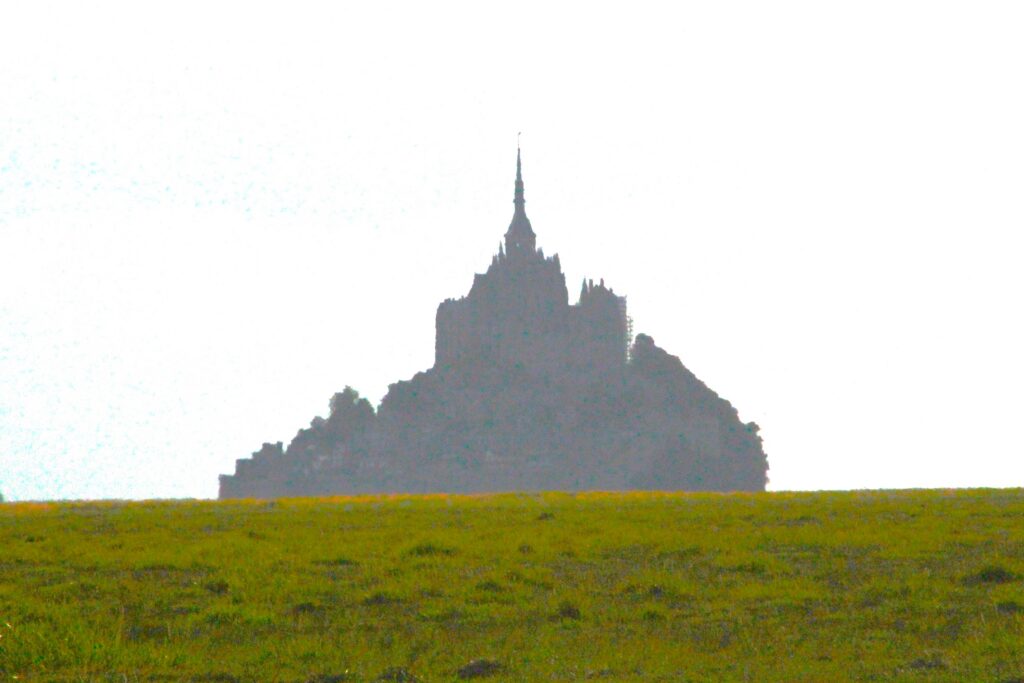
Mont St Michele must be the most famous location in Normandy, so it made our list of places to visit. There is no doubt the town is pretty, but when we visited it was so crowded it was hard to enjoy it. We much preferred the view of it over the marshes from the hotel where we stayed.
Le Harvre
The discovery of the trip for us was Le Havre. We planned to stay there to break our journey back to England but did not expect much, knowing that, although it is over 500 years old, it had been destroyed by bombing (mostly British) towards the end of the Second World War. But we enjoyed the slightly gritty feel of the city (it is France’s second busiest port) and, surprisingly, its concrete architecture. After the war, it was rebuilt based on a grand city design produced by Auguste Perret, who was a tutor of Le Corbusier. This and having so many buildings in a similar style gives it a sense of planned unity, somewhat like St Petersburg, although the style is rather different! The new cathedral is worth a visit.
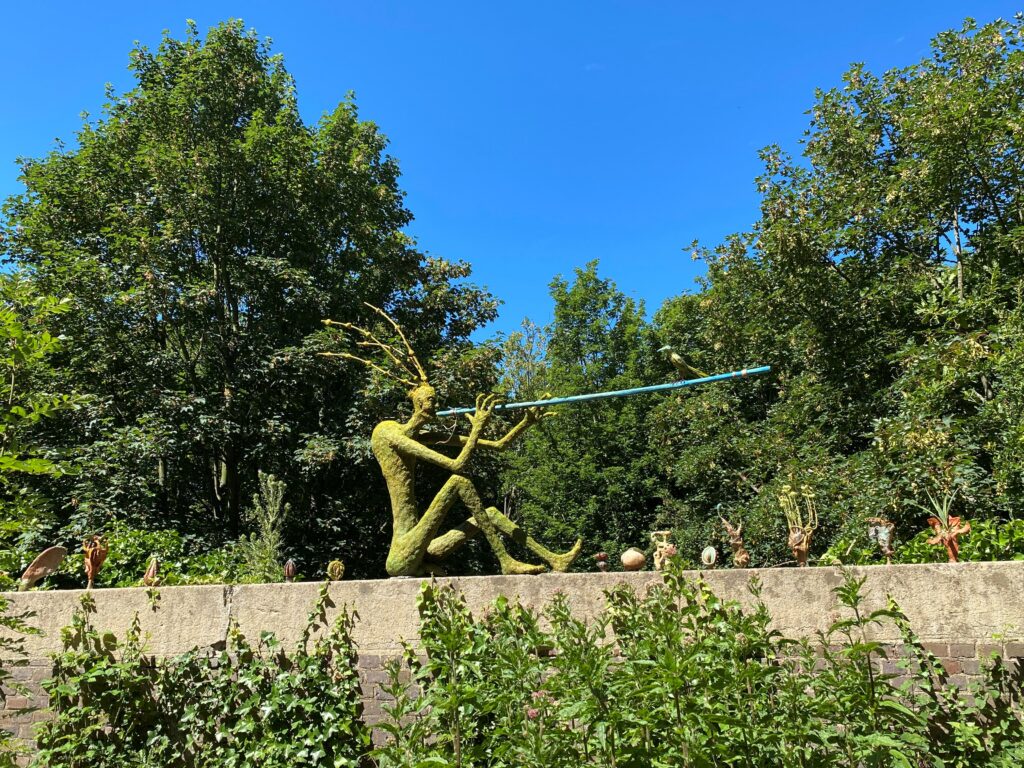
Probably our favourite place in Le Havre was the Botanical Gardens, Les Jardins Suspendus. The gardens are housed in a disused fort sat on a hill above the centre of town. We didn’t expect our visit to last more than a couple of hours but in the end, we spent half a day there and still hadn’t seen everything we wanted. In addition to the permanent plant displays (different themes in each of the four corners of the fort) there are also hothouses in the centre and exhibition spaces for art works. When we visited the main work on display was, appropriately, a sculpture of a tree by a Brazilian artist, Henrique Oliveira, Leafless and lying on its side inside part of the fort’s walls it was impressive. We also enjoyed the section of the garden where they had living sculptures (picture above).
Le Havre also turned out to be a good place to eat. We had a very enjoyable croissant and coffee breakfast in a café where we seemed to be the only people who were not local (a first for the trip). We also had a great meal at Restaurant Jean Luc Tartarin It was exactly what you would expect of a two Michelin star French restaurant. We went for the tasting menu. Everything was beautifully presented (although there was no skimping on portions), with an emphasis on seafood (but no moules-frites) and the service was excellent. When we expressed some mild disappointment over one dish (having none-the-less eaten it with enjoyment) the service team brought us an additional course free of charge! We walked home very full and satisfied.
When we visited: 24th June – 3rd July 2022
Leave a Reply