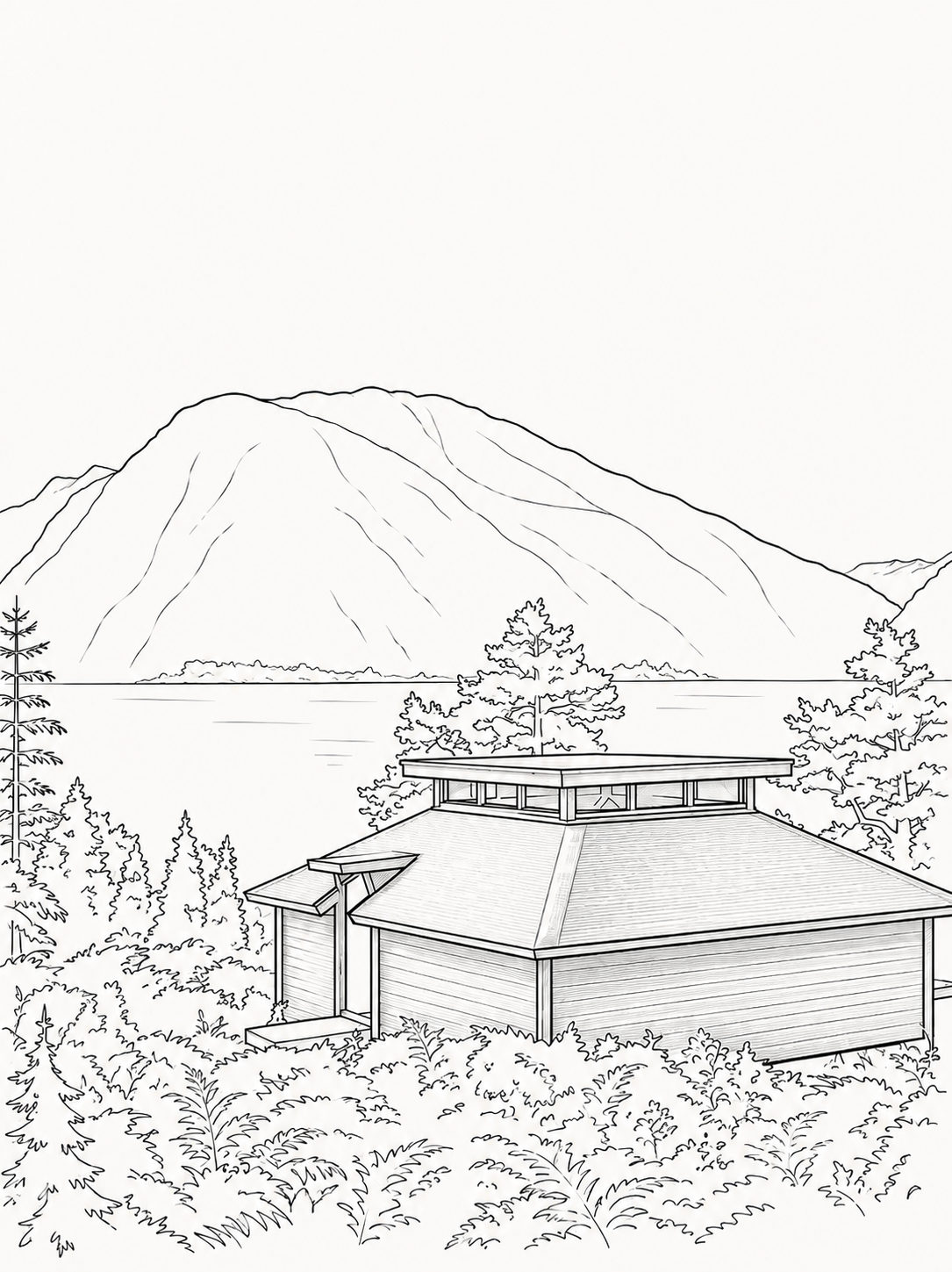
The fact that we decided to visit Norway two Julys in a row tells you something about how much we enjoyed the country.
On our first visit, we flew to Bergen and stayed there for a couple of days before setting off on a circular journey: by train to Flåm, by ferry to Balestrand, and then—after four days in nearby Dragsvik—back to Bergen by ferry. The second year we headed straight to Dragsvik.
Bergen
Bergen is pretty in exactly the way we imagined a Norwegian port city would be—lots of colourful old wooden buildings and a harbour full of small boats at its heart. Vågen, the old inner harbour, is the most picturesque, but the outer harbour also has its own charm.
Bryggen, Bergen’s former merchant quarter and its best-known tourist attraction, occupies one side of Vågen. Its rows of wooden warehouses preserve the distinctive character of the period when Bergen was a major centre of Hanseatic trade. The city became wealthy through stockfish: unsalted fish, usually cod, dried outdoors in the cold air and wind of northern Norway.
Behind the harbour-facing façades is a network of narrow passages containing workshops, galleries and small shops. Together, they offer some sense of what the district must have felt like in its heyday.
In July, Bryggen and the fish market (which sits right at the end of the same harbour) are full of tourists. So, once we had explored Bryggen, we kept away from these areas. We were surprised how different everything felt just a few streets away from the crowds. Some of the best times we had in Bergen were simply walking around the quieter areas enjoying the soft sunshine and weatherboard houses and wondering what was round the next corner.
One surprising discovery was a church (Bergen Domkirke, which to be precise is a cathedral) that had a cannonball embedded in one of its walls. Apparently, this dates from the Battle of Vågen in 1665 during the Second Anglo-Dutch War. Trying to escape an English naval squadron, a Dutch merchant fleet carrying a valuable cargo took shelter in Bergen’s harbour. Although Denmark-Norway was neutral, the king had secretly planned to cooperate with the English. Unfortunately, the royal command to protest but not intervene did not reach Bergen before the English attacked. As a result, the Dutch ships and Bergen’s shore defences returned fire, forcing the English squadron to withdraw. But not before they had fired the cannonball, which still serves as a reminder of their visit!
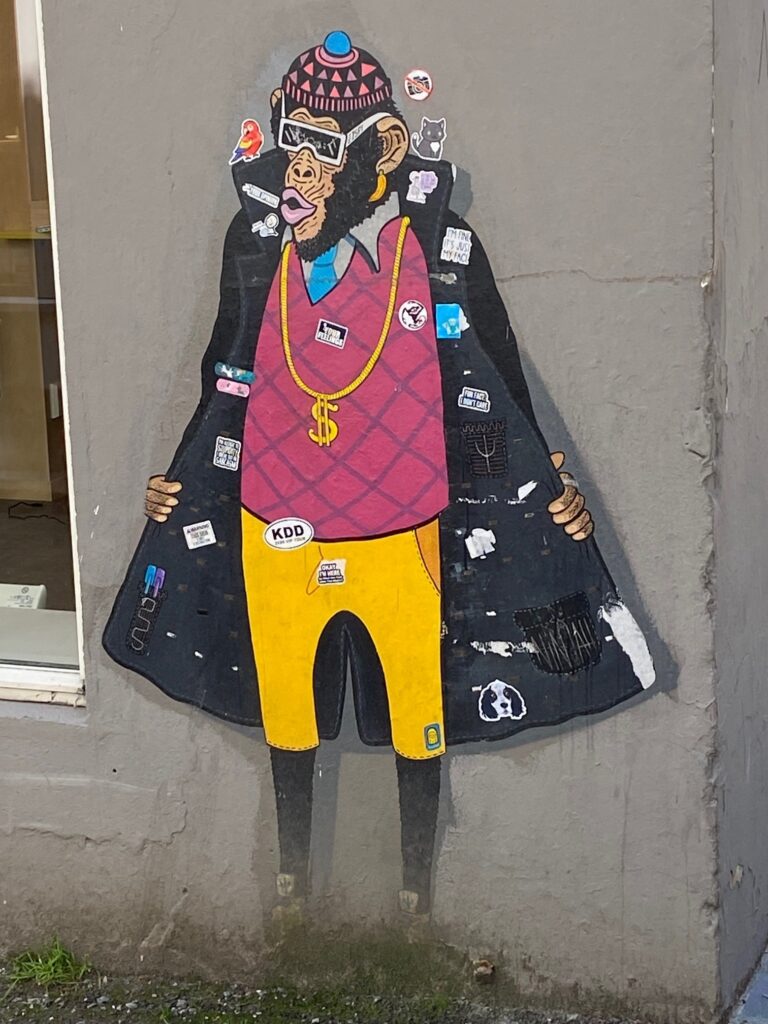
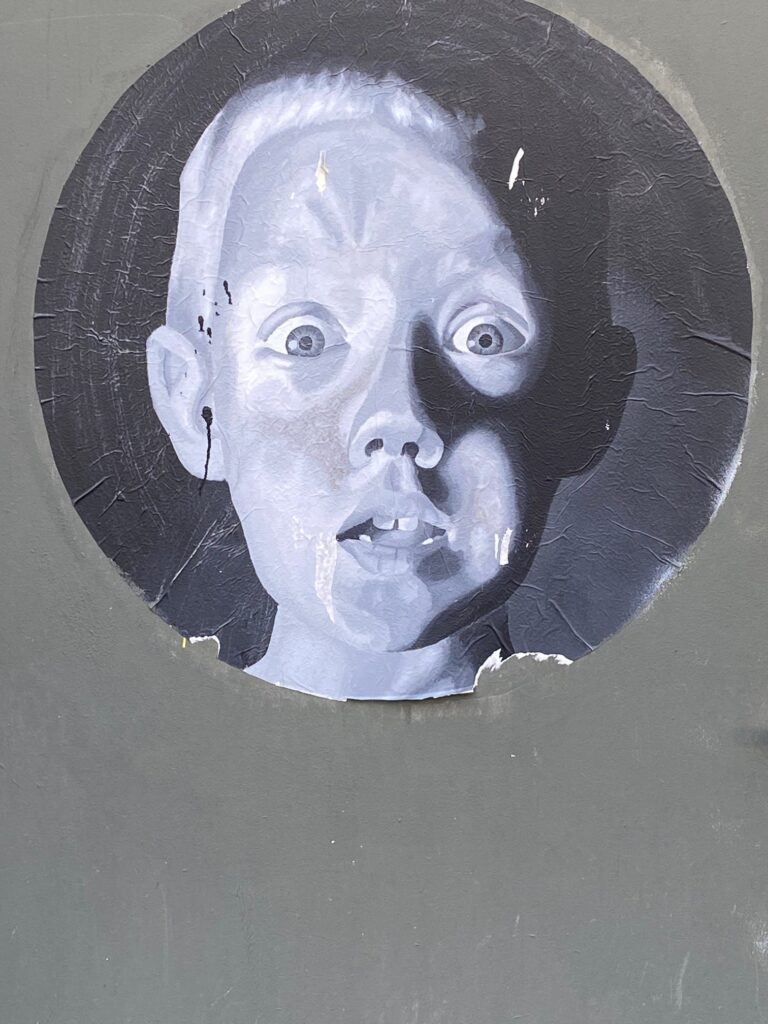
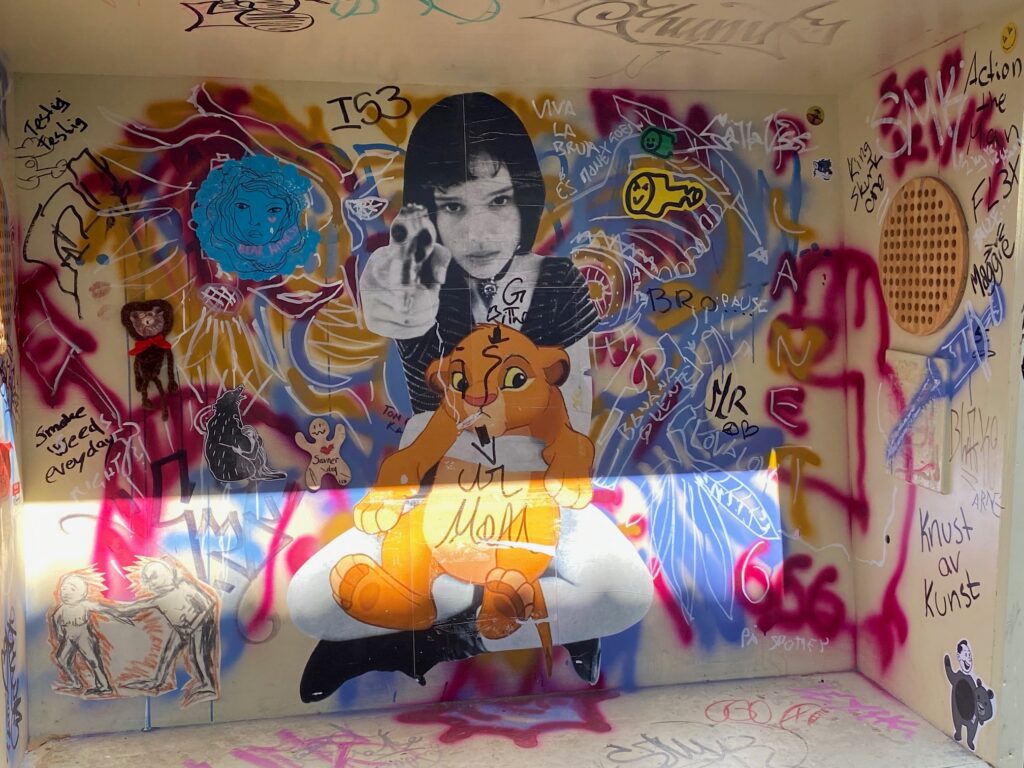
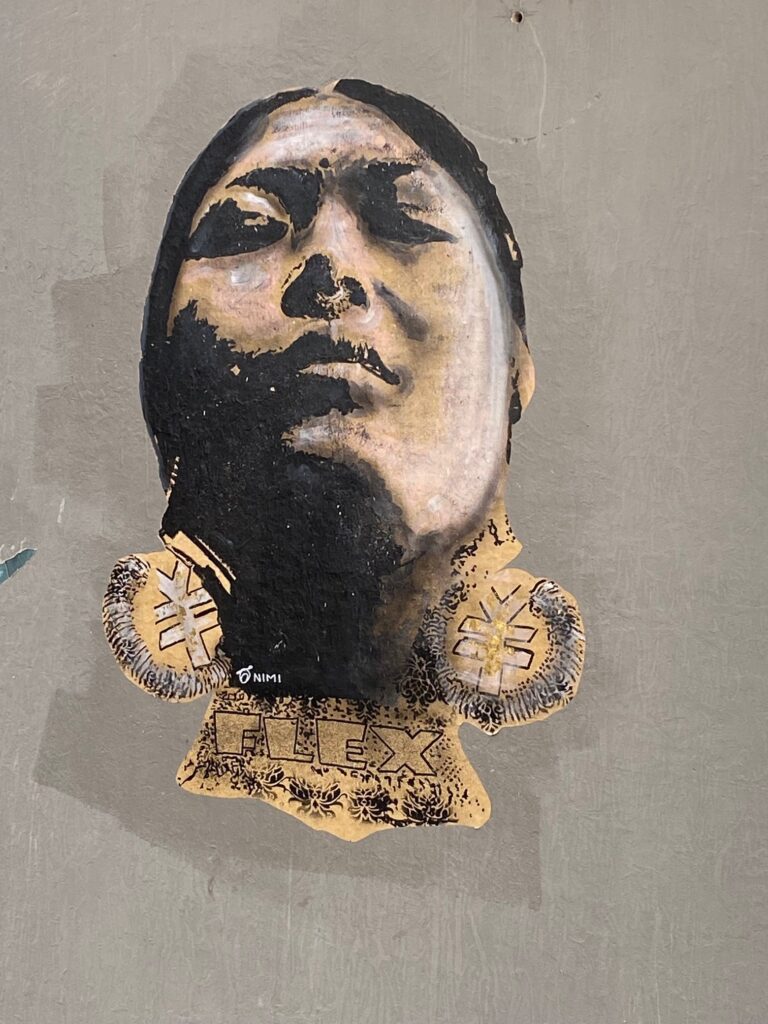
Another, more modern surprise on our walks around town was the number of murals we saw. After we had spotted a couple, we started to look out for them and were soon seeing them everywhere. They ranged in size from a giant troll that filled the whole of a side of a three-storey building to little pieces of graffiti not more than a few centimetres across. We ended up taking more photos of them than of anything else.
Parts of the fort that featured in the Battle of Vågen are still standing on one side of the port, a little further out to sea than Bryggen. We spent an interesting hour wandering around it. The highlights were Håkon’s Hall and the Rosenkrantz Tower (which you can climb, although we didn’t). The hall dates from the 13th century, when Bergen was Norway’s capital. As well as being the royal residence, it was also a reception hall and ceremonial banqueting space. Although the Rosenkrantz Tower incorporates a medieval keep dating from around 1270, much of its present appearance results from the work of Erik Rosenkrantz, the Danish governor of Bergenhus, in the 1560s. And, yes, the governor did belong to the aristocratic family from which Shakespeare borrowed the name for his character in Hamlet.
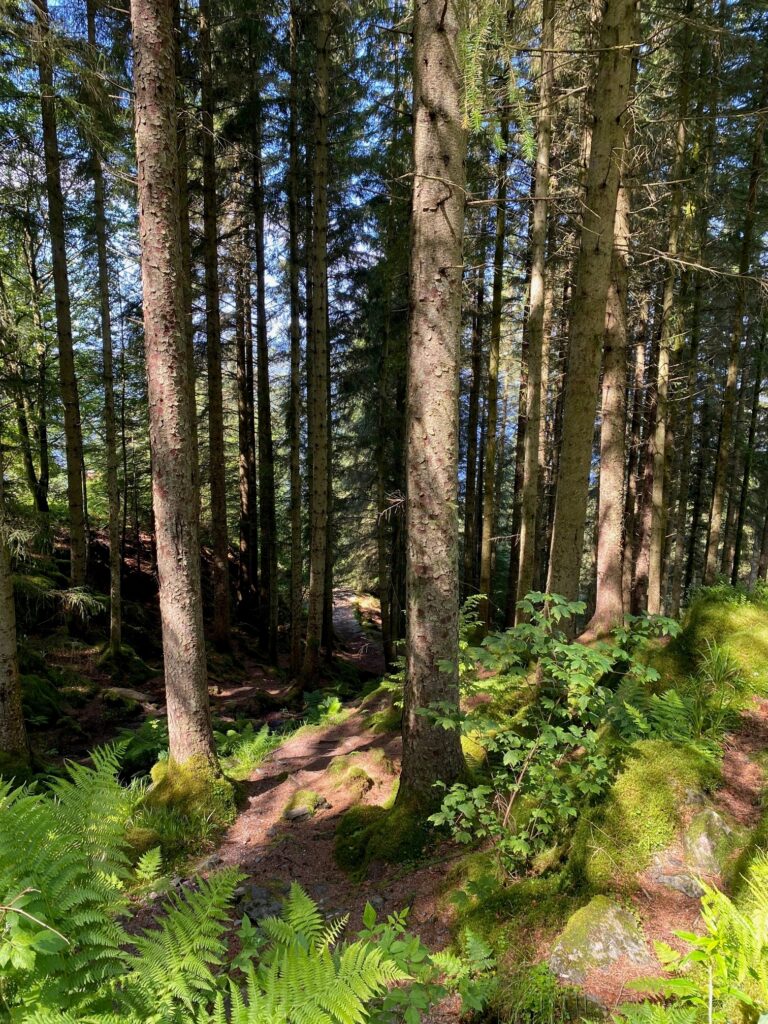
On our second day in Bergen, we took the funicular to the top of Mount Fløyen, which offers spectacular views over the city. Mount Ulriken, another nearby mountain with views that are supposed to be even more dramatic, can be reached by cable car. Unfortunately, it takes longer to get to and we did not have time to visit both. Once you get to the top of Fløyen, you realise it is more than a viewpoint. Behind the upper station is an extensive network of forest roads and trails. We opted to ride up and walk down, enjoying the beautiful forest and the views over the harbour and city.
On the way back to London, we visited the Rasmus Meyer Museum (also known as KODE 3), one of several museums run by KODE in and around Bergen. It has a permanent display of Norwegian painting from the early 19th century through the first decades of the 20th century. As we had expected, there was a substantial collection of work by Edvard Munch, including many paintings that were new to us. We also enjoyed discovering Norwegian artists whose work we had not encountered before.
There are a host of good places to eat in Bergen. The fish market, with its numerous food counters, is very popular. We decided to avoid the crowds and did not try it. Some of the places we did try include:
Søstrene Hagelin: a traditional fish-food shop (founded by the two Hagelin sisters in 1929) rather than a formal restaurant. You order and collect your food at a counter and can then sit and eat at one of the canteen-like tables. We’ve had lunch there three times now and think it a good sign that every time more than half the customers have been locals. On our visits, we’ve tried plukkfisk (flaked cooked fish and onions mixed with mashed potato), fishcakes, fish soup, fish gratin and bacalao. The plukkfisk was particularly good.
Lysverket: an adventurous restaurant that adds a modern twist to regional produce and seafood. We had the tasting menu with a drinks pairing featuring several unusual choices, including Norwegian cider. The food was good and the whole evening a real experience.
Trekroneren: a tiny kiosk near the harbour that started selling hot dogs more than 75 years ago. It offers a variety of sausages and accompaniments. We tried reindeer with fried onions and lingonberry and even after the rave reviews we had read, were not disappointed. It is possible to have your sausage wrapped in a lompe (flat potato pancake). But when we asked about this option, we were told that the real way to eat a Trekroneren hot dog is in a bun. Doing anything else just proves you are not from Bergen!
Train journey
We left Bergen on an ordinary Norwegian Railways train and changed at Myrdal, where we took the mountain railway that runs from there down to Flåm, a small town on one of the branches of Sognefjord. The journey from Bergen to Myrdal was worth taking just for the scenery. As the train made its way up to nearly 900 metres above sea level, we got our first real sense of the amount of space there is in the Norwegian countryside.
When we changed at Myrdal it was immediately obvious from the passengers that the mountain railway that runs from there down to Flåm now operates mainly for the benefit of tourists. It wasn’t always that way. Originally, the line was built as a link between the fjord settlements and the national railway system, making it easier to bring in freight and passengers. Construction started in 1923. It tells you something about the difficulty of the task that it wasn’t completed until 1940.
The line descends more than 860 metres in just 20 kilometres, which meant the engineers who designed it had to use sharp curves and 20 tunnels. For those of you who are interested, this is a conventional adhesion railway—using neither cogwheels nor cables—despite gradients of up to 1 in18.
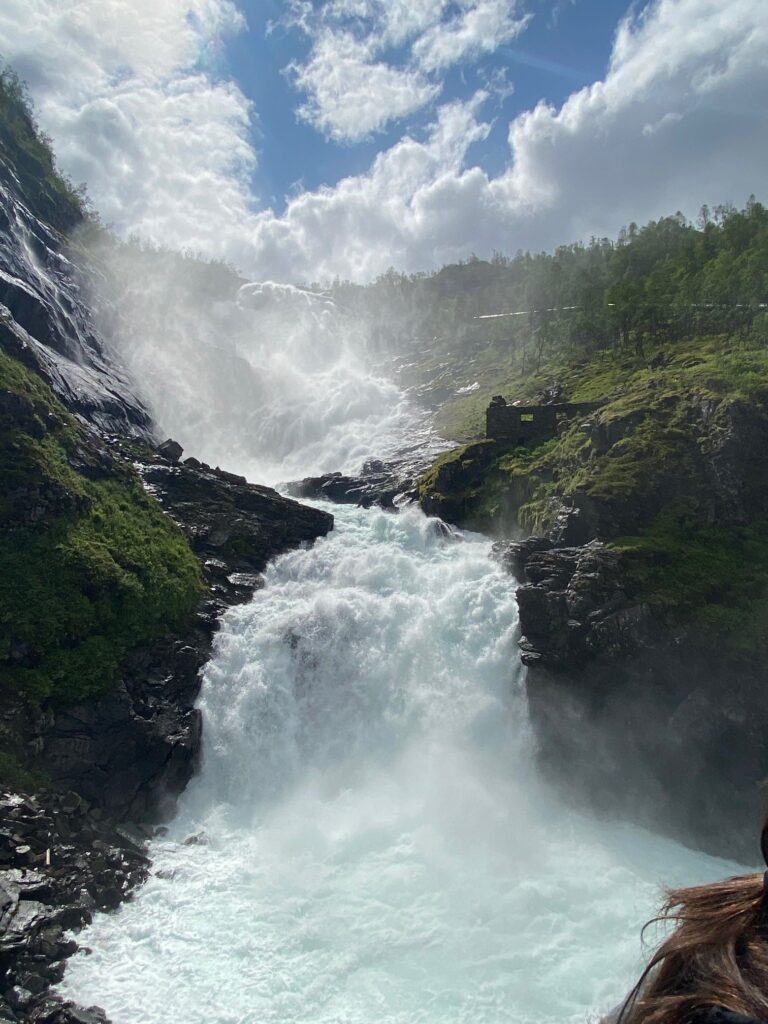
This makes it an exhilarating trip, but the most exciting part is what you can see out of the windows. At one point the train stops for about five minutes to allow passengers to get out and view the Kjosfossen waterfall. When we visited, the 90-metre drop was producing an immense amount of white water. At several points on the journey the spray from waterfalls was enough to create mini-rainbows.
Flåm, when we arrived, was swamped with passengers from a huge cruise ship that was tied up there and the town had the feel of a place that lived off the tourist trade. We were pleased to get on the ferry to Balestrand.
Balestrand and Dragsvik
Balestrand is one of the stops on the Flåm-Bergen ferry route. We chose it as a place to stay mainly for logistical reasons: the four-and-a-half-hour journey to Bergen meant that we could travel from there to London in a single day. Although Balestrand is small, we decided—again largely by chance—to stay in the still smaller settlement of Dragsvik, a short bus journey away.
We arrived at Dragsvik Fjordhotel late in the evening. Rather than a room in the main hotel building, we had taken one of their cabins. When we woke up the next morning, we realised what a good decision that had been.
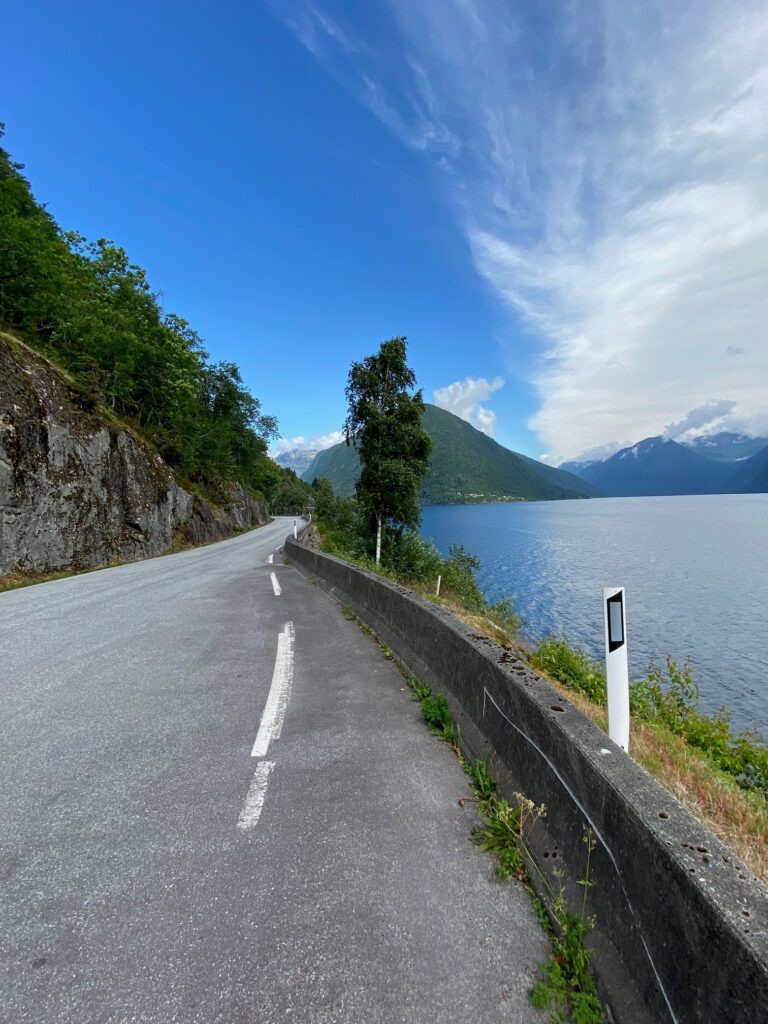
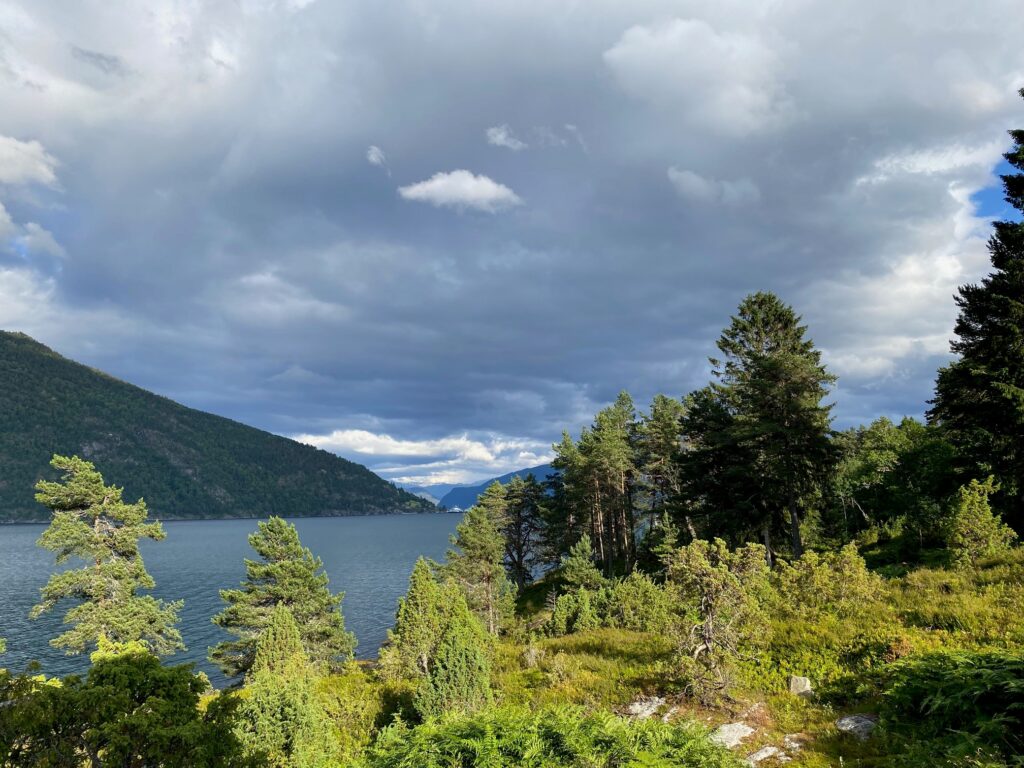
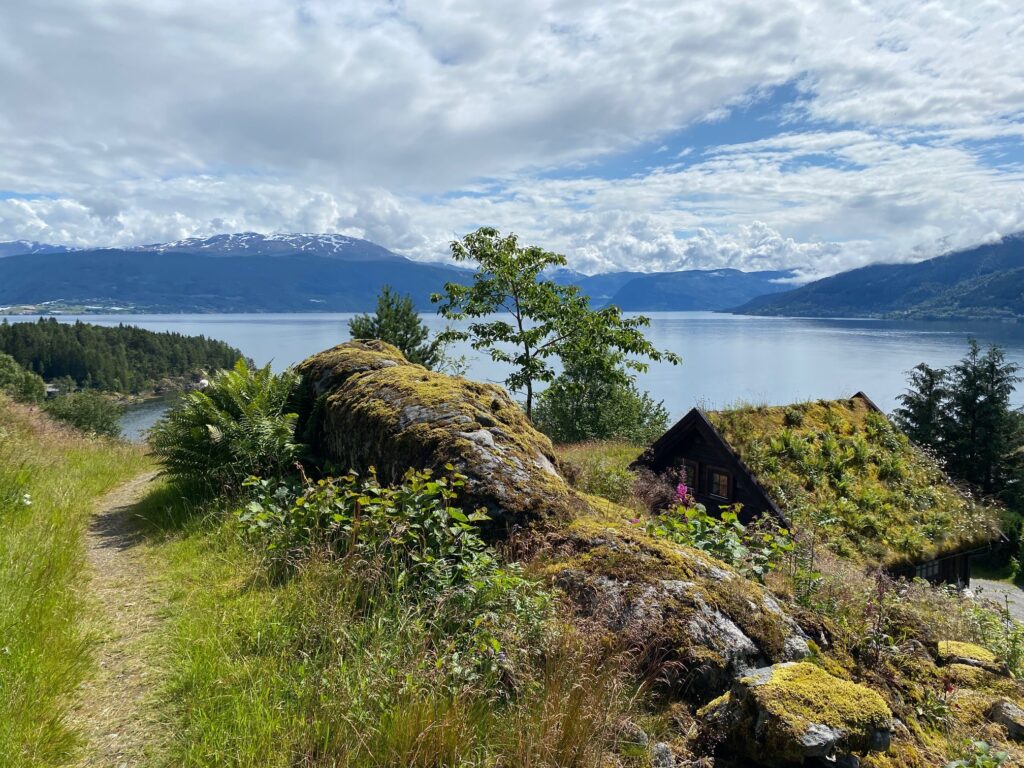
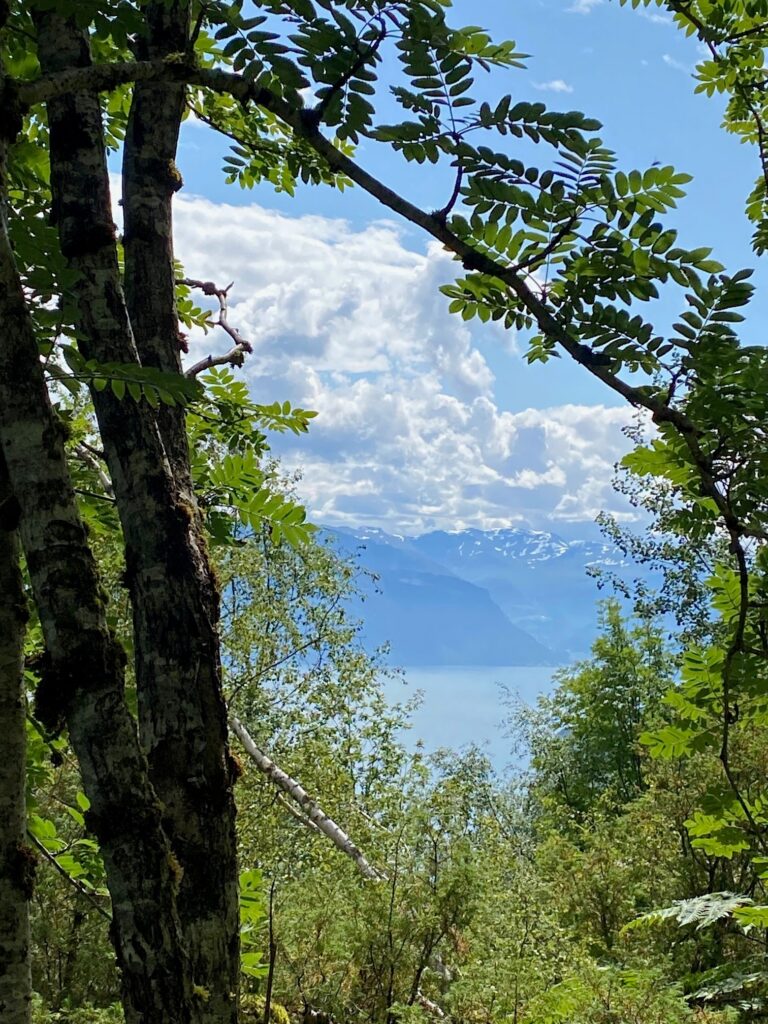
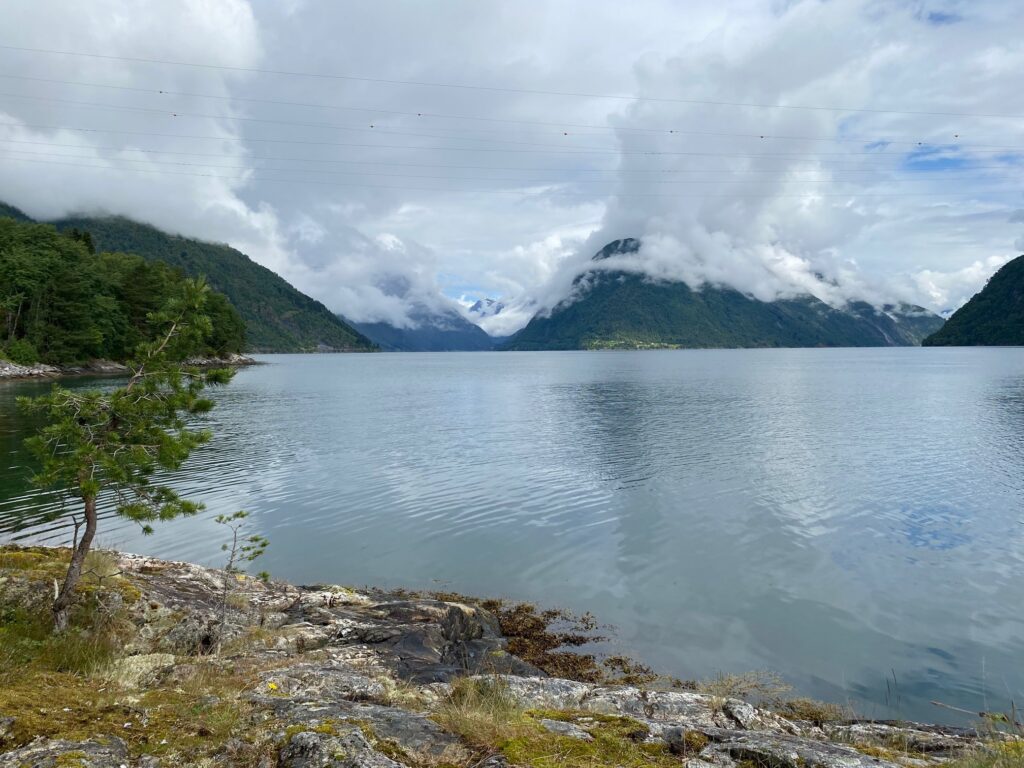
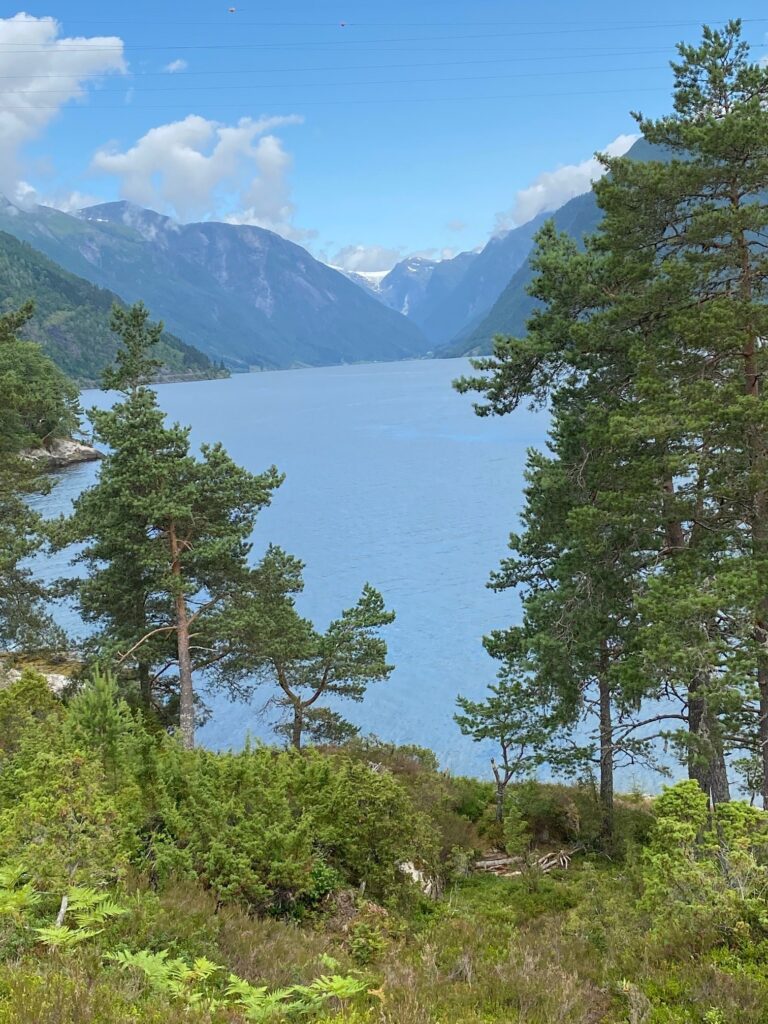
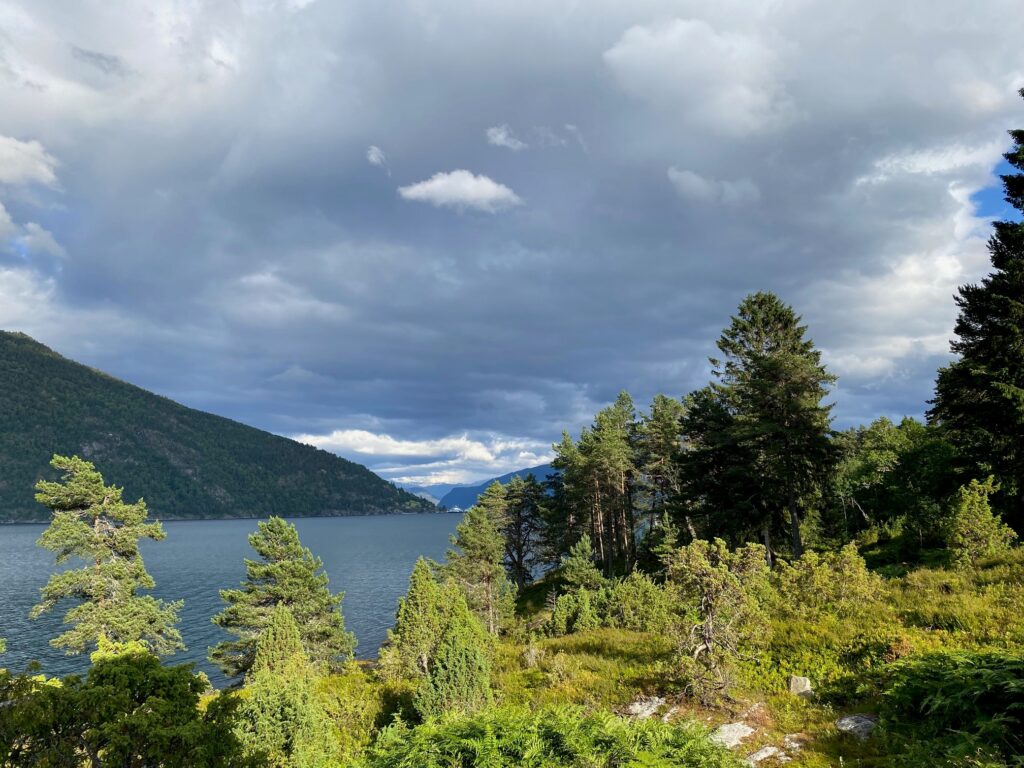
Perhaps it was because we had uninterrupted views of trees, water, mountains and snow from the cabin’s small veranda. Perhaps it was because we were close enough to the fjord to hear the waves breaking. Or perhaps it was because we were surrounded by blueberry bushes covered in so many berries that it took just ten minutes to collect enough for breakfast. Whatever the reason, we instantly knew we had found our own special small corner of Norway.
The place had captured us.
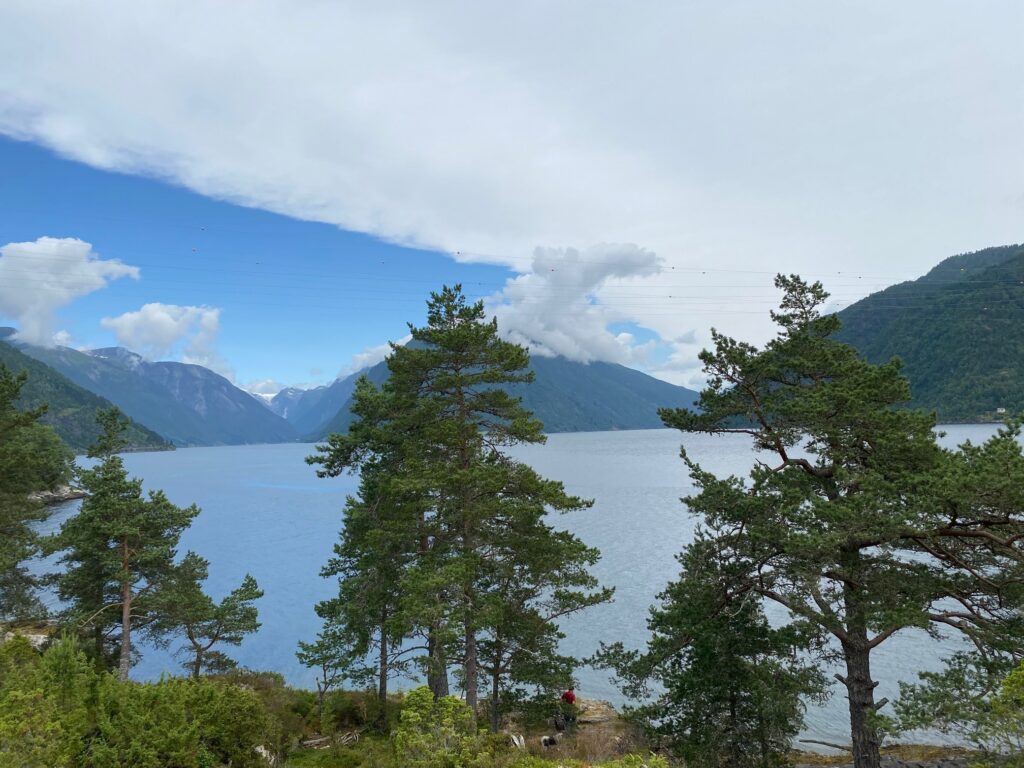
Although there is plenty to do in and around Dragsvik (including a fantastic range of walks), what we enjoyed most was sitting on the cabin’s veranda watching the view and listening to the waves. After the constant hum of London, we found the calm more restorative than anything else we could imagine.
Even the rain—and Norway has plenty of it—did not spoil the feeling. When it came, we sat inside reading and looking through the picture window at the scenery. They say there are certain places where a person feels they belong. For us, Dragsvik is one of them. Perhaps somewhere in Norway there is a small stretch of fjord for each of us.
When we visited: 1st-8th July 2025 and 7th-14th July 2026

Leave a Reply