When we were thinking about where to go for a spring weekend break, Vienna somehow seemed the perfect place . So we took the plunge and booked our flights. We were not disappointed.
One of the best things about Vienna is what a delightful city it is to walk around. The centre is full of grand baroque and nineteenth century buildings. Scattered amongst them are other gems from ancient Roman ruins to modernist masterpieces. So, as you would expect in a city that was the capital of first the Holy Roman Empire and then the Austrian Empire, there is something to discover around every corner.
One is the Naschmarkt, Vienna’s largest market which we were told is called “Vienna’s stomach” (or der Bauch von Wien) by locals. How true that is I don’t know, but the display of foodstuffs from around the world – cheeses, spices, dried fruits and a lot more – is unquestionably impressive. Mixed in with the food stalls are a host of cafes and restaurants with offerings from a wide range of cuisines, meaning the market is a place where most people should be able to find something they would like to eat.
At the heart of the city Stephansplatz, Vienna’s central square is another great place for a stroll. To one side of it is Stephansdom, the cathedral that gives it its name. The gothic façade combined with the coloured tiles that cover its roof, make it visually striking from the outside. We didn’t buy tickets to go in, but if you do there is a lot of history to appreciate. Started in 1137, much of today’s building dates from the 14th century. Apparently, it was the the venue for Mozart’s wedding and the funeral of Antonio Vivaldi. Under it there are catacombs containing the remains of 11,000 people, including the burial urns containing the entrails of 56 Habsburg family members.
The cathedral is not the only interesting building around the square. The Haas House on the western end is which is a post-modern style building finished in 1990, Building it so near the cathedral caused a huge scandal. We rather liked it.
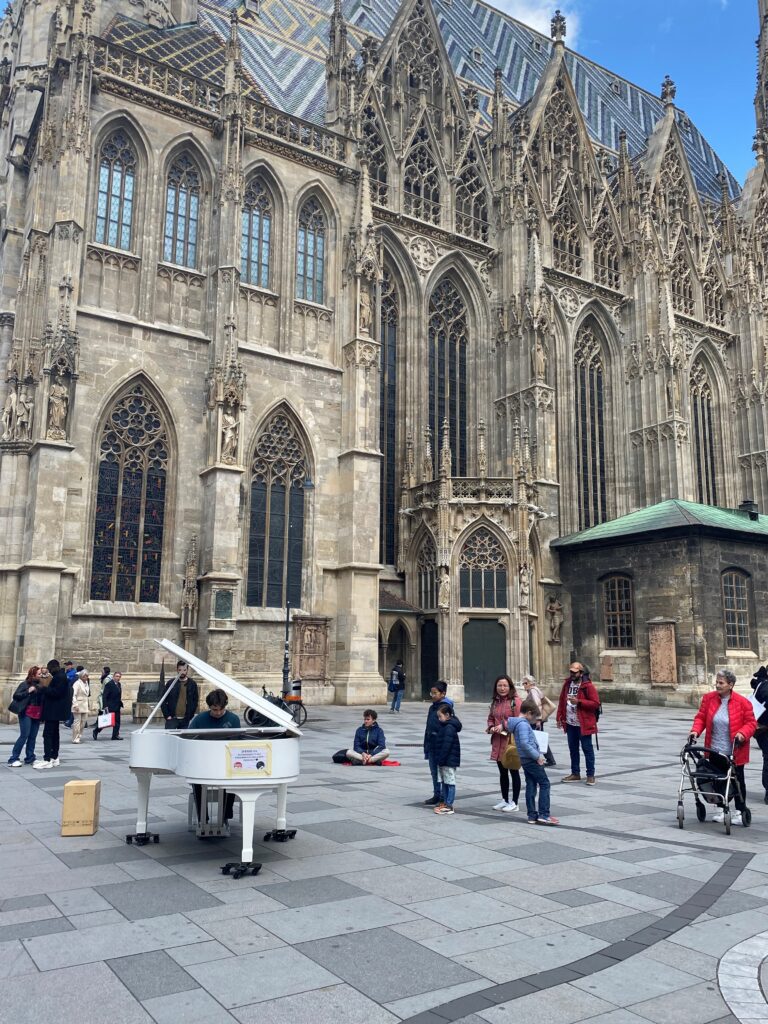
But I think the thing we most enjoyed when visiting Stephansplatz was the pianist giving an outdoors recital in the square.
For a sense of imperial grandeur it would be hard to beat the Belvedere which is both a palace (two actually since there is an upper and a lower palace in the same grounds) and an art gallery. The Upper Belvedere has an art collection focused on Austrian Art. Gustav Klimt is one of the highlights – his “Kiss” is there as well as several of his other less well-known works including some landscapes which were interesting discoveries. Some of the other works by artists we did not know (e.g. Schiele) were also really powerful. Tip if you visit: buy your tickets online and avoid waiting in the queue. Entrance is by time slot.
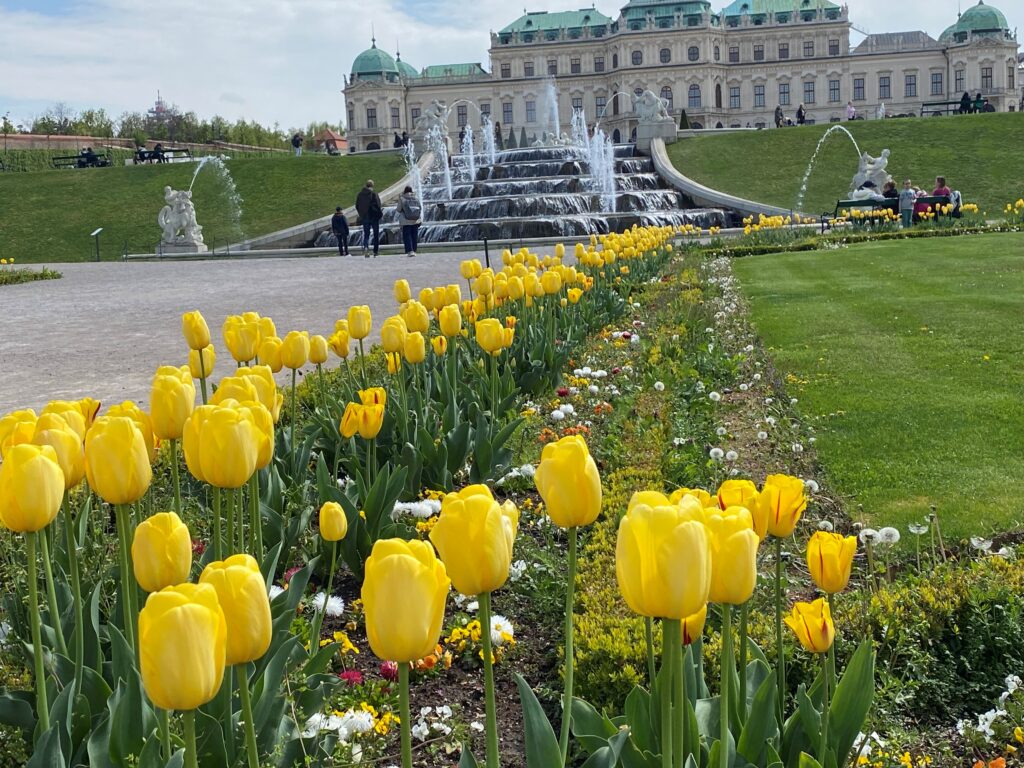
Even if you are not in the mood for art, the grounds of the Belvedere make another great walk. They contain some amazing fountains. Gardeners however, are obviously in short supply – two robots were cutting the grass when we visited!
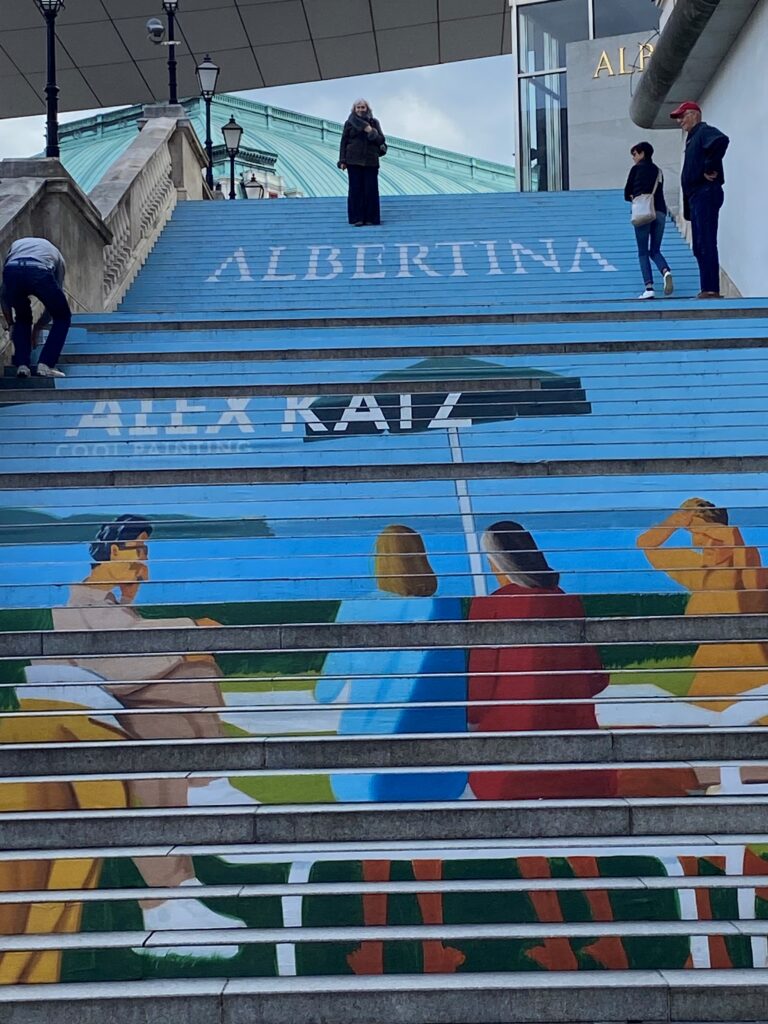
There are enough art galleries and museums in Vienna for a year of long weekends, so, with only three days, we had to be selective. Including the Albertina amongst those we did visit was a good choice. It turned out to be even better than we had hoped. Its collection is focused on modern and contemporary paintings -Monet, Cezanne, Degas, Matisse, Chagall, Kondinsky, Modigliani, Munch, Miro are amongst the artists represented. Picasso has three rooms devoted to him. Some of the less well-known artists painting during this period were a discovery for us as well as some of the individual works of other artists. One of the Munch’s in particular made a lasting impression. There was Apart from the main Albertina there is the Albertina Modern which we didn’t visit.
The Spanish Riding School, which claims to be the oldest riding school in the world (it was founded in the 16th century) and its famous Lipizzaners are Vienna institutions. So, even though they weren’t at the top of our list of things to see, we decided to visit. It turned out to be another good decision. Instead of going on a guided tour or to a public performance, we went to see the them practicing at the the Winter Riding School. Both the building and the horses were more impressive than we had expected.
Although the practice sessions are very popular with tourists (complete sell out when we went) they are just part of the horses’ routine training . The the only concession to tourists like us were some brief comments from an anonymous announcer over a loudspeaker. What she had to say was worth listening to. We were surprised to learn that all the “tricks” performed by the horses are based on natural movements but that only stallions are trained since the mares don’t feel the need to show off in this way. It was also interesting to find out that individual horses have preferences for certain movements and that they are trained to perform the ones they enjoy most.
After watching the horses, we visited the Palais Eskeles which now houses part of the Jewish Museum of the City of Vienna. The museum looks at Jewish history in Vienna from the Middle Ages to today. Arriving at it, the police presence outside was very visible. We had lunch at Café Eskeles (you can visit the café without going into the museum itself) and were surprised to find that most of the tables were reserved (they seem to have a lot of regulars). The menu is vegetarian and vegan food cooked in an Israeli/Mediterranean style and focuses on local products. It is well worth a visit if you are looking for something a bit unusual.
The closest we came to a disappointment during out visit to Vienna was the river cruise we took on the Danube. We had hoped for some spectacular views of the city and on the route we took there were some interesting buildings, including some brutal modern architecture, but overall the experience was not as exciting as we had hoped.
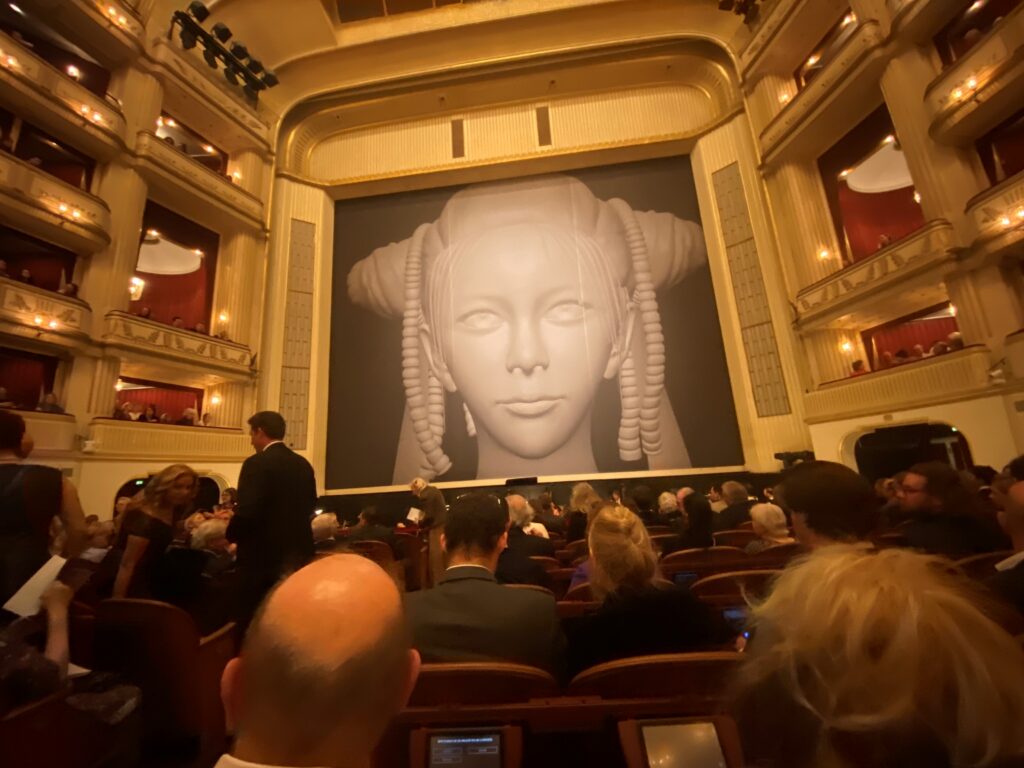
| Of course, being in Vienna, one of the things we had to do was visit the Opera. When we were there Carmen directed by Calixto Bieito was playing with Anna Goryachova singing the lead role. Arriving at the theatre, we had, based on what we had seen in Salzburg, expected the whole audience to be dressed very smartly. So, we were surprised to see that although a lot of the audience were in evening dress, there were plenty of people dressed quite casually. The quality of the singing was excellent – we were particularly impressed by the chorus – and enjoyed the whole evening even though the modern interpretation, complete with a nude male dance tableau in the middle of the performance, might not be to purists’ taste. |
Our other evening in Vienna, we visited Steirereck which at the time was listed as one of the top 20 restaurants in the world. It lived up to the rating. The first striking thing about the restaurant is its location in a modern building (actually it was built in 1904 but has had a modern overhaul) in the Stadt Park. With glass on the outside and wood/concrete on the inside it had a sophisticated but relaxed feel. We chose the tasting menu with wine pairing as this was the best way to experience a wide range of the chef’s creations and the skill of the chief sommelier in matching each dish. When they started to arrive, the dishes were beautifully presented, and if there was a theme, it was, like the building, giving a modern twist to Austrian tradition. Every ingredient, quite a few of which we had not experienced before, had a story that the waiters were happy to explain. So, we felt we were being educated as well as fed. One of the things the restaurant obviously prides itself on is its trolleys. It has them for everything from aperitifs to digestifs. We will remember the bread trolley (more than 25 different types of bread) and the great cheese selection (after explaining what we liked the trolley attendant made perfect choices for both of us). It was the ideal end to a great trip.
When we visited: 25th-27th April 2023
Leave a Reply